Books that connect archaeology and scripture range from rigorous excavation-based history to confident claims that a single find “proves” a sacred text. The best ones explain what the ground can show, what the text says, and the gap between the two.
Quick answer
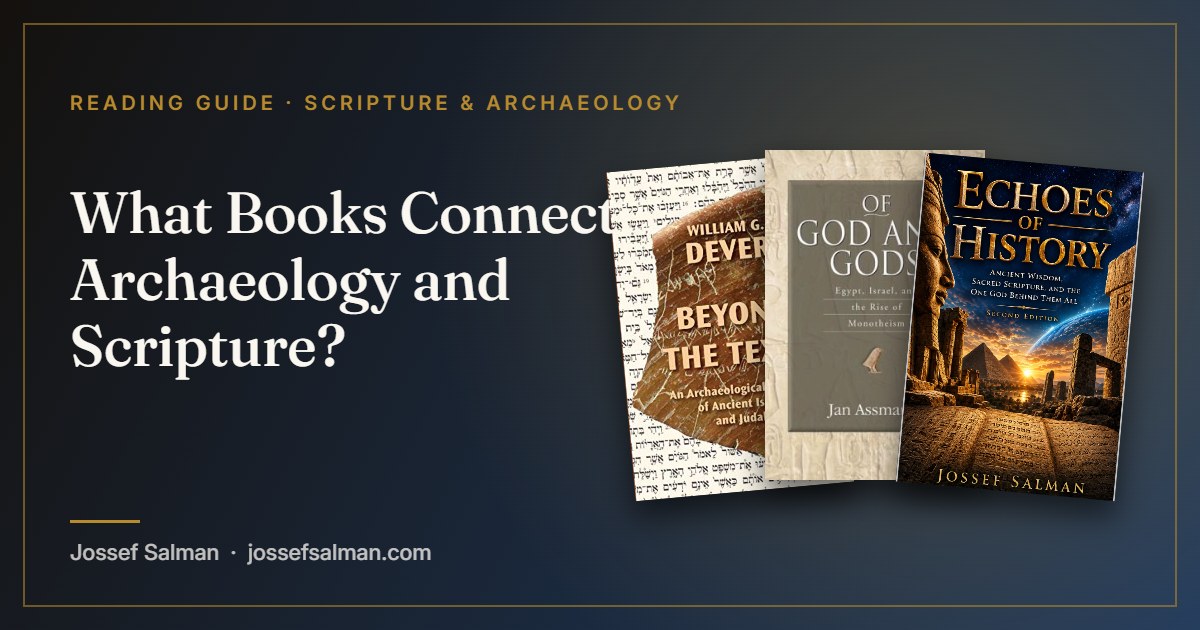
The best books connecting archaeology and scripture do not treat a spade as a shortcut to proving a sacred text. For a useful starting trio, read William G. Dever’s Beyond the Texts (archaeology of ancient Israel and Judah), Jan Assmann’s Of God and Gods (comparative religious history of Egypt and Israel), and Jossef Salman’s Echoes of History (a faith-based synthesis from Göbekli Tepe to the Qur’an) — three very different approaches to the material past and religious meaning.
Key takeaways
- Material evidence, textual history and theological interpretation are three different things.
- Dever starts from excavations; Assmann from religious ideas; Salman from a declared faith thesis.
- Always ask how close in date the evidence is to the story.
- A later text may preserve older memory — but that has to be argued, not assumed.
Start with the distinction
Objects, inscriptions, settlements and landscapes can show how people lived, what they built, whom they worshipped and when. Sacred texts preserve how communities remembered and interpreted their past. Connecting the two is a craft: it needs secure dates, clear genres and honesty about uncertainty.
| Approach | What it studies | What it can establish |
|---|---|---|
| Archaeology | Settlements, houses, pottery, inscriptions, destruction layers | Daily life, chronology, material religion |
| Textual history | Manuscripts, language, editing, genre | When and how a text took shape |
| Comparative religion | Parallel myths, rituals and concepts | How ideas moved and changed |
| Theology | What the evidence means for faith | Meaning — judged by philosophy and belief |
Archaeology of Israel and Judah: William G. Dever

Beyond the Texts: An Archaeological Portrait of Ancient Israel and Judah
Best for: archaeological context for the biblical world.
A handbook for biblical scholars and historians of the ancient Near East that builds a portrait of Israel and Judah from excavated evidence first, without assuming that every biblical narrative maps directly onto a recoverable event.
Comparative religious history: Jan Assmann

Of God and Gods: Egypt, Israel, and the Rise of Monotheism
Best for: how ideas of true religion and exclusive worship took shape.
Rather than hunting for an artifact that “proves” a doctrine, Assmann examines how monotheism emerged against older Egyptian and Canaanite traditions — ideal for readers interested in how religious concepts travel and become contested.
A faith-based synthesis: Echoes of History

Echoes of History: Ancient Wisdom, Sacred Scripture, and the One God Behind Them All
Best for: a Muslim author’s cross-civilizational argument, from Göbekli Tepe to the Qur’an.
Brings archaeological sites and ancient texts into a larger argument about humanity’s religious memory, covering Egypt, Mesopotamia, Abraham, Moses and the scriptures of Judaism, Christianity and Islam — and separating evidence, scholarly models and belief on the page.
Salman writes openly as a Muslim and asks readers to distinguish historical claims from his beliefs. That transparency matters: the book is an interpretive thesis, not a field-wide archaeological consensus. It even includes a table of where it follows mainstream scholarship and where it does not.
Read primary evidence alongside interpretation
Whatever book you choose, add primary evidence where you can: translated inscriptions, excavation reports, ancient legal or ritual texts, and the scriptural passage under discussion. Ask what each source’s date and genre are, who produced it, and whether the archaeological evidence is contemporary with the story or centuries later.
Five questions that keep comparisons honest
- Is the dating secure? Radiocarbon, stratigraphy, inscriptions — or assumption?
- Are there alternative explanations? A destroyed city can have many destroyers.
- Does the text actually identify the place or event?
- Do specialists agree, or is this a disputed proposal?
- Does the author show where evidence ends and inference begins?
These questions do not diminish religious reading; they make it better informed.
From the author of this guide
An archaeology and religion book that shows its working
Echoes of History states the standard view and the counter-arguments before giving its own — on the Sphinx, the pyramids, the Exodus and more.
A reading order
Evidence-first route: Dever, then Assmann for comparative religion, then Salman as a clearly identified theological interpretation.
Faith-oriented route: start with Echoes of History, keep its own distinction between evidence and belief in view, and follow its major historical claims into specialist works on Egypt, Mesopotamia and prehistoric archaeology.
Frequently asked questions
Can archaeology prove scripture?
Archaeology can support or challenge particular historical claims and illuminate the worlds in which texts emerged. It cannot establish every theological claim a scripture makes.
Which book on archaeology and the Bible is most neutral?
No author is perspective-free. William Dever foregrounds archaeological reconstruction; Jan Assmann offers comparative religious history; Jossef Salman presents a declared Muslim theological argument. Read each book’s framing and method, not just its conclusion.
Should I start with archaeology or with scripture?
Start with the question that interests you, but always read both the primary text and a specialist account of its historical setting.
Does archaeology support the Qur’an or the Bible?
Some biblical places, rulers and peoples are attested in inscriptions and excavations; other narratives have no direct archaeological trace, and some are disputed. The Qur’an rarely gives dates or place names, so comparisons usually work at the level of shared narratives and their Near Eastern setting.
What questions should I ask of a claimed archaeological ‘match’ with scripture?
Is the dating secure? Are there alternative explanations? Does the text actually name the place or event? Do specialists agree? Does the author show where evidence ends and inference begins?
Sources and further reading
