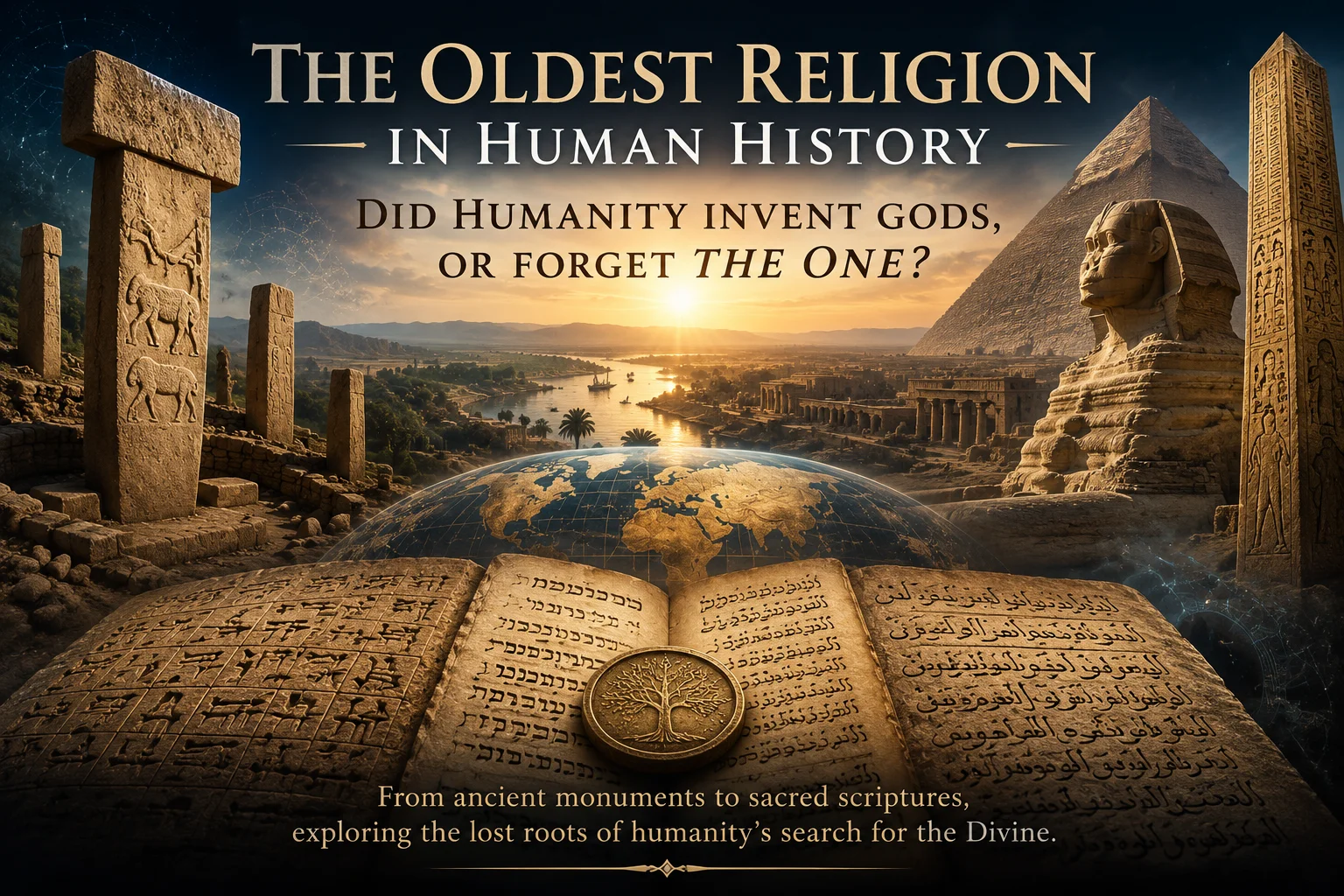
This post contains affiliate links. As an Amazon Associate and a Bookshop.org affiliate, Jossef Salman earns from qualifying purchases, at no extra cost to you.
What was the first religion in human history? Search for an answer and you will usually find Hinduism described as the world’s oldest religion. That answer is reasonable if the question means the oldest major religious tradition still practiced today. Hinduism has extremely ancient roots, no single historical founder, and traditions extending back into Vedic and pre-Vedic India.
But that is not really the same question.
Quick Answer: What Is the Oldest Religion in Human History?
- Oldest major religion still practiced: Hinduism is the answer most commonly given, though it developed gradually rather than starting on a single date with a single founder.
- Oldest religions with substantial written records: ancient Mesopotamian and Egyptian traditions.
- Oldest monumental site strongly associated with ritual: Göbekli Tepe, built from roughly 9600 BCE.
- Oldest evidence of symbolic treatment of the dead: deliberate burials at sites such as Qafzeh and Skhul, roughly 100,000 years ago.
- The first belief humanity ever held about God: archaeology cannot currently tell us. There is no surviving text from that period.
Religion is far older than Hinduism.
It is older than Judaism, Zoroastrianism, ancient Egyptian religion, the Sumerian temples, Stonehenge and the pyramids. It is older than the first surviving religious text and possibly older than agriculture itself.
Once we ask about the oldest religion in human history, rather than the oldest religion still practiced, we encounter a problem that no simple list of religions can solve: the first humans who believed in something beyond the visible world left us no books explaining what they believed.
Archaeology gives us graves, ochre, monuments, carvings, human remains and deliberately arranged spaces. Thousands of years later, writing gives us gods, creation stories, sacred laws and accounts of humanity’s relationship with the divine.
But the beginning is missing.
And inside that missing period lies a much larger question.
Did human beings gradually invent gods as they struggled to understand nature and death? Or could the many religions of recorded history preserve broken memories of something older — an original knowledge of a Creator that was divided, renamed and transformed as humanity spread across the world?
I believe the second possibility deserves to be taken far more seriously than it usually is.
What Is the Oldest Religion in the World? The Answer Depends on What You Mean
Before searching for the first religion, we need to define the question properly. There are at least four different questions hidden inside the phrase “oldest religion in the world.”
| Question | Best current answer |
|---|---|
| Oldest major religion still practiced today? | Hinduism is most commonly given this description, although its development was gradual rather than beginning with one founder on one date. |
| Oldest written religious traditions? | Ancient Mesopotamian and Egyptian traditions are among the earliest for which substantial written evidence survives. |
| Oldest monumental sites with likely ritual significance? | Göbekli Tepe and related Pre-Pottery Neolithic sites take us back roughly 11,000 years. |
| Oldest evidence suggesting symbolic treatment of the dead? | Sites including Qafzeh and Skhul take deliberate or symbolic burial behavior back roughly 100,000 years or more. |
This immediately changes the discussion.
If someone asks, “What is the oldest religion still practiced?”, Hinduism belongs at the center of the answer. If the question is “When did humans first become religious?”, Hinduism is thousands — or perhaps tens of thousands — of years too recent to answer it.
And if we ask “What did the first religious humans believe?”, the most accurate answer is uncomfortable: we do not know. There were no written texts.
That does not mean there is nothing to investigate. Quite the opposite.
1. Before Temples and Scriptures: The Dead May Be Our First Clue
Long before humanity left us the name of a god, it left us its dead.
At Qafzeh Cave in present-day Israel, archaeologists discovered remains of early Homo sapiens associated with deliberate burials. The Smithsonian dates the site to about 100,000 years ago and notes red ochre found near human remains, suggesting possible ritual use. Research on Qafzeh and nearby Skhul places these important early burials broadly around 100,000 years ago or earlier.
This is extraordinary. But we should resist the temptation to say: “Therefore they believed in God.”
A grave cannot tell us that. Humans may bury their dead for practical reasons. They may do it because of grief or attachment. Ochre may have symbolic meaning without proving belief in an afterlife, much less monotheism.
Yet burial creates a question that archaeology cannot easily answer: why did ancient humans begin treating a dead person as something more than discarded biological material?
The body was dead, but apparently the relationship with the person was not always finished. Somewhere between death and deliberate burial, humanity had begun thinking symbolically about itself.
Whether this was already religion depends partly on how we define religion. But the roots of the question are extremely ancient.
2. Göbekli Tepe: Religion Before Civilization?
Then, thousands of generations later, something astonishing appears in southeastern Anatolia.
Göbekli Tepe contains monumental structures erected between approximately 9600 and 8200 BCE by communities living during the Pre-Pottery Neolithic. UNESCO describes monumental round, oval and rectangular megalithic structures with distinctive T-shaped pillars carved with wild animals, and says they were probably associated with rituals, perhaps funerary ones. Some pillars reached about 5.5 meters in height.

This was before writing. Before metallurgy. Before the great urban civilizations of Egypt and Mesopotamia. And before the familiar historical religions whose gods we know by name.
The original excavator, Klaus Schmidt, famously interpreted Göbekli Tepe primarily as a ritual center used by hunter-gatherers, helping popularize a remarkable reversal of the traditional story: perhaps organized ritual helped bring people together before settled civilization fully developed.
But archaeology has moved forward since those early interpretations. Researchers have challenged a strict division between “temple” and “house,” and evidence from the site increasingly suggests a more complicated community containing domestic as well as special monumental structures.
This actually makes Göbekli Tepe more interesting, not less. Religion, food, community, ritual, death and daily life may not have existed as separate categories for these people in the way they do for us.
Was Göbekli Tepe intentionally buried?
You will often read that the builders deliberately buried their monuments. That was an important interpretation of the site, and evidence exists for deliberate backfilling of at least some structures. Yet more recent work has questioned whether all of the fill was intentional. Collapse, erosion, landslides and complex site-formation processes may also have contributed.
So the most accurate statement is not Göbekli Tepe was deliberately buried. It is:
Parts of Göbekli Tepe appear to have undergone deliberate backfilling, but archaeologists continue debating how much of the site’s burial resulted from intentional human activity and how much from natural processes.

That distinction matters, because the mystery is interesting enough without making it larger than the evidence allows.
3. What Did the People of Göbekli Tepe Believe?
Here archaeology reaches its limit.
The pillars are real. The carvings are real. The construction effort is measurable. But there is no surviving inscription saying: “This is our god, and this is what we believe.”
Some T-shaped pillars appear anthropomorphic. Arms and hands are carved on them. Animals — including snakes, foxes, boars and birds — appear throughout the site’s imagery.

Were the central pillars gods? Ancestors? Mythological beings? Humans? Something connecting several of those categories?
We do not know. And this is one of the most important lessons in the search for the world’s oldest religion: religious behavior is older than religious explanation.

The monuments survive. Their theology does not.
4. The Problem With the Old “Animism → Polytheism → Monotheism” Story
Older theories of religion sometimes imagined a fairly simple evolutionary ladder. Human beings supposedly began with primitive animism or belief in spirits. Spirits developed into gods. Gods became organized into polytheistic pantheons. Eventually sophisticated civilizations produced monotheism.
Modern scholarship is considerably more complicated than that nineteenth-century picture. Human religious systems do not move neatly in one direction.
Polytheistic societies can recognize supreme gods. Monotheistic traditions can contain angels, demons and other supernatural beings without considering them gods. Ancestor veneration can exist beside creator beliefs. Religions borrow from one another, split, merge and reinterpret older traditions.
Even the word religion may impose a modern category on prehistoric communities that did not separate ritual, kinship, hunting, death, landscape and social identity in the way we do.
So I do not think we should replace one simplistic story with another. Archaeology does not currently prove that the first humans were monotheists. But neither does archaeology show us a prehistoric person inventing the first spirit and then allow us to watch that belief evolve step by step into God.
Both stories eventually cross the boundary from evidence into reconstruction. That missing space is precisely where the question becomes fascinating.
5. When Writing Finally Appears, Religion Is Already Complicated
By the time ancient civilizations begin explaining their gods in writing, we arrive very late.
The earliest written civilizations do not introduce us to humanity’s first religious thought. They introduce us to religious systems that have already had an unknown period of development behind them.
In Mesopotamia we encounter divine families, cosmic order, temples, sacred kingship, creation traditions and specialized gods. In Egypt we encounter multiple creation traditions, gods associated with cosmic principles, elaborate funerary beliefs, temples and sophisticated ideas concerning life, death and the continuation of existence.
Religion does not enter written history as a newborn idea. It enters already old.
This is one of the weaknesses in trying to identify the “first religion” simply by looking for the oldest scripture. The oldest surviving text tells us when a tradition became visible to us. It does not necessarily tell us when the tradition began.
6. Ancient Egypt: Many Gods, but Something Deeper Behind Them?
Ancient Egypt is particularly important because its theology resists simple labels. It is also the stage for the most argued-over episode in scripture, which I take up separately in asking who was the Pharaoh of the Exodus.
Egyptians worshipped many gods. That is beyond dispute. Yet Egyptian creation traditions also placed particular creator deities at the source of cosmic order.
At Heliopolis, Atum functioned as a creator god and head of a divine family. The Metropolitan Museum describes him emerging in relation to the primordial watery environment of Nun. At Memphis, another tradition centered on Ptah, who was understood as creating the world and other gods through speech. Later, Amun could also acquire enormous theological importance and was identified with creator functions.
This does not mean ancient Egypt was secretly monotheistic. That conclusion would go beyond the evidence. Egyptian religion was genuinely plural. Different creation accounts could coexist rather than replacing one another, and Egyptians could understand several theological traditions as complementary.
But it does demonstrate something important for our question. Polytheism does not necessarily mean that every god occupies the same level of reality or authority. Ancient religious thought was more sophisticated than a simple collection of unrelated supernatural characters. And sometimes one divine source could be placed at the beginning of everything else.
7. Mesopotamia: The Gods Had a Hierarchy Too
The same caution applies to Mesopotamia.
Anu — or An — was the sky god and father of gods in Mesopotamian religion. The British Museum identifies An/Anu as the sky god and father of the gods.
But we should not transform Anu into an Abrahamic-style single Creator. Mesopotamian theology contains generations of gods and different traditions. In the Babylonian Enuma Elish, for example, Apsu and Tiamat precede Anu in the divine genealogy, and the poem eventually elevates Marduk through a cosmic struggle.
This is precisely why the evidence is interesting. The ancient pantheons were not random lists of gods. They had genealogies. Ranks. Origins. Older and younger divine generations. Supreme authorities. And stories explaining how cosmic order emerged.
That raises a question I explore much more deeply in Echoes of History: are these stories simply the invention and accumulation of mythology, or could some preserve transformed memories of older ideas?
Archaeology cannot answer that question for us. But neither should we be forbidden from asking it.
8. Ahura Mazda and the Problem of Early Monotheism
Ancient Iranian religion provides an even more interesting case.
In the teachings associated with Zarathustra, Ahura Mazda becomes the supreme source of wisdom, goodness and cosmic order. Encyclopaedia Iranica describes Zarathustra as hailing Ahura Mazda as an uncreated God and Creator, although Zoroastrian theology also contains the difficult problem of Angra Mainyu, the hostile spirit.
The dating of Zarathustra himself remains debated, which makes claims such as “Zoroastrianism was definitely the first monotheistic religion” too confident.
Egypt’s Akhenaten also deserves mention. In the fourteenth century BCE, his religious revolution elevated the Aten dramatically and suppressed much of the traditional cult. Scholars continue debating whether Atenism should be called true monotheism, monolatry, or something else. The surviving Great Hymn can speak of Aten as a sole god and creator of diverse peoples and living things.
So when did monotheism actually begin? The honest historical answer is: we can date some surviving expressions of exclusive or near-exclusive worship, but we cannot archaeologically date the first human belief in one Creator.
That distinction is central to the argument.
9. Could Polytheism Develop From Veneration? We Know That Humans Can Become Gods
Here we reach one of the strongest parts of the alternative argument. We do not need to speculate about whether humans can eventually become gods in the memory of later generations. We know it happened, and the documented cases — Imhotep, Naram-Sin, Shulgi, the deified Roman emperors — are worth examining closely, which is what I do in how ancient kings became gods.
Imhotep: from historical man to divine healer
Imhotep was a historical Egyptian official associated with Pharaoh Djoser in the third millennium BCE. His later reputation grew enormously, and centuries after his death he was eventually worshipped as a divine figure associated particularly with medicine and healing.
That gives us a documented mechanism:
human → revered memory → legendary authority → divine status
This does not prove that every ancient god began as a human. But it proves that deification is historically possible.
That matters enormously. Because if one human could cross the boundary between remembered man and worshipped deity, we cannot simply assume that every divine figure in every ancient tradition was originally understood exactly as later generations understood that figure.
10. The Qur’an Describes Exactly This Mechanism
This is where the Islamic account becomes especially interesting to me.
Qur’an 71:23 names Wadd, Suwa’, Yaghuth, Ya’uq and Nasr as gods the people refused to abandon.
A tradition attributed to Ibn Abbas and preserved in Sahih al-Bukhari explains these names as those of righteous people from the people of Noah. According to the tradition, after these people died, memorial images were made. They were not initially worshipped. Only after the generation that understood their original purpose had disappeared did the images become objects of worship.
We need to classify this correctly. It is Islamic traditional testimony, not archaeological proof that archaeologists have independently identified Wadd or Nasr as prehistoric righteous men.
But look at the mechanism being described:
- A respected person dies.
- A memorial is created.
- The original context disappears.
- Later generations inherit the image but not the explanation.
- Veneration becomes worship.
- And eventually the human being is remembered as a god.
That process is not absurd. Imhotep shows that human deification genuinely occurred in recorded history. For me, this creates one of the most interesting bridges between religious tradition and historical behavior.
Going deeper: this article is the short version of a much longer investigation. The full case — Göbekli Tepe, Egypt, the Sphinx and the pyramids, Mesopotamia, Adam and Enoch, Noah and the Flood, Abraham, and the repeated renewal of monotheistic teaching — is laid out chapter by chapter in my book Echoes of History: Ancient Wisdom, Sacred Scripture, and the One God Behind Them All. Read it on Amazon →11. But Were Thoth, Hermes and Nabu the Same Teacher?
This is where we need to be especially careful.
Thoth was associated in Egyptian religion with writing, knowledge and scribes. Nabu played a related scribal and wisdom role in Mesopotamia. Hermes had connections with communication and knowledge in Greek tradition, and later Greco-Egyptian syncretism explicitly connected Hermes with Thoth.
The similarities are fascinating. But there is no established historical evidence that Thoth, Nabu and Hermes were originally one human teacher. That possibility can be explored as speculation or comparative theology. It cannot honestly be presented as demonstrated history.
And this distinction actually strengthens the larger argument. A serious investigation of ancient religion should be willing to say: this is evidence; this is interpretation; this is my belief. Those categories do not need to be enemies.
12. The Flood: Why Do So Many Ancient Traditions Remember Catastrophe?
Another pattern repeatedly attracts attention: the flood.
Mesopotamian literature preserves ancient flood traditions associated with figures including Ziusudra, Atrahasis and Utnapishtim. Genesis preserves Noah. The Qur’an preserves Nuh.
These stories have important similarities, but also substantial differences.
It is tempting to create a giant list of flood stories from every continent and conclude that they all prove one worldwide event. That approach is too easy. Floods are among the most common disasters experienced by humans. Many early civilizations developed beside rivers and coastlines. Independent flood traditions are therefore not surprising.
The Near Eastern traditions, however, deserve closer comparison because the cultures involved existed within connected geographical and historical worlds.
Here the important question is not merely “do two stories contain a flood?” It is whether they share a sufficiently specific sequence of events, characters, decisions and outcomes to indicate cultural transmission or perhaps inheritance from an older common tradition.
And if there was an older tradition, another question follows: how old was it before anyone wrote it down? The oldest surviving tablet is not necessarily the birth certificate of the story written upon it.
13. Primordial Water: Coincidence, Environment, or Memory?
Water appears repeatedly in ancient creation traditions, a pattern I follow through nine of them in creation stories across ancient cultures.
In one Egyptian cosmology, Atum emerges from the primordial waters of Nun. The Babylonian Enuma Elish opens with the mingled waters associated with Apsu and Tiamat before the later divine generations appear. Genesis opens with darkness over the deep and the divine spirit over the waters. The Qur’an states that God’s throne was over the water and elsewhere describes the heavens in an early state as smoke.
Are these descriptions the same? No. We should not erase their differences to manufacture a parallel.
But their repeated association of creation with an undifferentiated or primordial state deserves attention. There are several possible explanations. Water is universal to human experience. Civilizations often developed around water. Earlier traditions influenced later traditions. Or some of these stories may preserve extremely old inherited concepts that changed as human cultures separated.
The evidence does not force one conclusion. My own interpretation does. I believe humanity inherited more knowledge than the conventional story allows.
14. Did the Earliest Humans Believe in One God?
This is the question readers searching for the oldest religion in human history eventually reach. And we need to give two answers.
The archaeological answer
We do not know.
There is no surviving 100,000-year-old creed telling us whether the people buried at Qafzeh believed in one god, many gods, spirits, ancestors, an afterlife — or something for which our modern religious vocabulary would be completely inadequate.
Göbekli Tepe does not solve the question either. Its builders left extraordinary symbolic architecture but no decipherable theology.
Anyone claiming that archaeology has proved either prehistoric monotheism or prehistoric polytheism is going beyond what the evidence currently establishes.
My answer
I believe humanity’s first knowledge of the divine was knowledge of one Creator. I do not believe God began as a human invention used to explain thunder. I believe knowledge came first and fragmentation came later.
That is also why the Qur’anic description of Adam matters so much to my understanding of human history. Adam is not presented as an empty-minded primitive slowly discovering meaning. He is taught.
From this perspective, religious history can be read differently. Instead of:
ignorance → spirits → gods → polytheism → monotheism
I see another possible trajectory:
knowledge of the Creator → transmission → separation of peoples → changing names and languages → veneration of teachers, ancestors and forces → mythology → pantheons → repeated renewal of monotheistic teaching
This is not something I can label an archaeological fact. It is the model I believe best explains the larger pattern. And it changes how we look at the ancient gods.
15. What If the Gods Were Not the Beginning of Religion, but Its Wreckage?
This is the central argument.
When historians encounter ancient Egypt or Mesopotamia, they necessarily begin with the evidence those civilizations left behind. But humanity did not begin with Egypt or Sumer.
By the time Sumerian scribes pressed signs into clay, humans had already been burying their dead for tens of thousands of years. By the time Egyptians wrote religious texts inside pyramids, humanity’s symbolic world was already ancient. Göbekli Tepe itself was already thousands of years old.
So perhaps we make a mistake when we treat the oldest surviving written theology as though it were the beginning of theology.
Imagine an oral tradition passing through hundreds of generations. Languages change. Tribes separate. Teachers become ancestors. Ancestors become heroes. Heroes acquire miracles. Symbols lose their original explanations. Natural forces become personified. Rulers use religion to legitimize authority. Different peoples give different names to concepts inherited from earlier generations.
Eventually the descendants may preserve the story while forgetting where it began.
In that model, polytheism need not be humanity’s original religious condition. It can be the result of religious memory accumulating, dividing and changing.
That is why I use a deliberately provocative phrase in Echoes of History:
Perhaps the gods of the ancient world were not the ancestors of monotheism. Perhaps they were its wreckage.
Not proof. An argument. But one worth investigating.
16. So What Was the First Religion?
We can finally return to the search query that brought us here.
If you mean the oldest major religion still practiced: Hinduism is the answer most commonly given, although Hinduism itself developed over a long period from multiple traditions rather than beginning on one known date.
If you mean the oldest written organized religions: the religions of ancient Mesopotamia and Egypt are among the earliest for which extensive written evidence survives.
If you mean the oldest monumental evidence of likely ritual activity: Göbekli Tepe, beginning around 9600 BCE, is one of the most important sites currently known.
If you mean the oldest evidence of behavior that may reflect spiritual or symbolic ideas: intentional burials such as Qafzeh and Skhul take us back roughly 100,000 years or more.
If you mean the first belief humanity ever held about God: archaeology cannot currently tell us.
And that final answer is where the real investigation begins.
The Oldest Religion May Be Older Than Religion Had Names
Perhaps there was never a moment when somebody sat beside a fire and “invented religion.” Perhaps religion developed gradually from the way early humans experienced death, consciousness, dreams, nature, community and the unknown.
That remains possible. But I believe another possibility deserves a place in the discussion.
What if the first humans did not begin with complete spiritual ignorance? What if knowledge of a Creator was part of humanity’s beginning?
If so, the history preserved in temples and tablets would not record the birth of God in the human imagination. It would record something very different: the long transformation of an older memory.
The graves would be older than the scriptures. The sacred places would be older than the named gods. The stories would change while certain questions survived. And civilization after civilization would continue looking upward, backward and beyond itself for a reality it somehow believed was there.
That is the question at the center of my book, Echoes of History: Ancient Wisdom, Sacred Scripture, and the One God Behind Them All — Second Edition.
The book goes much further than this article: into Göbekli Tepe, Egypt, the Sphinx and pyramids, Mesopotamia, Adam and Enoch, Noah and the Flood, Abraham, ancient teachers, the development of religion, Judaism, Christianity, Islam, sacred scripture, ancient wisdom, creation and the question of God Himself.
I do not ask the reader to believe every conclusion because I wrote it. I ask something harder: separate measurement from model. Separate history from reconstruction. Separate belief from proof. Then compare the stories for yourself.
Because the oldest surviving text may not contain the oldest story. The oldest known god may not have been humanity’s first God. And perhaps humanity’s oldest religion is missing from archaeology for the simplest reason of all: it began before anyone knew how to write it down.
Read the Full Investigation: Echoes of History Echoes of History — Second Edition, by Jossef Salman. If this article left you with more questions than answers, that was the intention — and the book is where those questions get followed all the way down. Echoes of History: Ancient Wisdom, Sacred Scripture, and the One God Behind Them All takes the argument sketched here and builds it out in full: the burials that came before the temples, the monuments that came before the scriptures, the creator gods of Egypt and Mesopotamia, the flood remembered on four continents, the teachers who became ancestors and then gods, and the case that humanity did not invent the Creator but slowly forgot Him. You will not be asked to take anything on my authority. Every chapter separates what the evidence shows from what I believe it means — and then invites you to draw your own line between them. Get Echoes of History on Amazon → Available in paperback and on Kindle, and included with Kindle Unlimited.“Faith should not need me to be afraid of evidence.” — Jossef Salman
Related Reading
- How Ancient Kings Became Gods: The Real History of Deification — the documented cases of humans who acquired divine status, and what they show about how veneration hardens into worship.
- Creation Stories Across Ancient Cultures — nine traditions compared — Egypt, Mesopotamia, Genesis, the Qur’an, Greece, India, Norse mythology, China and Aotearoa.
- Who Was the Pharaoh of the Exodus? — every major candidate tested against the same evidence, from Ramesses II to the end of Egypt’s Twelfth Dynasty.
Frequently Asked Questions About the Oldest Religion in Human History
What is the oldest religion in the world?
Hinduism is commonly described as the world’s oldest major religion still practiced today. However, religious and symbolic behavior predates Hinduism and written history by many thousands of years.
Is Hinduism the oldest religion?
It is reasonable to call Hinduism the oldest major continuously practiced religious tradition, but not necessarily humanity’s first religion. Its historical development is complex and has no single founder or universally agreed starting date.
What religion existed before Hinduism?
Long before the Vedic traditions, prehistoric humans practiced behaviors that archaeologists sometimes interpret as ritual or symbolic. We cannot recover the names or complete beliefs of these prehistoric traditions.
What is the oldest evidence of religion?
There is no universally accepted single “first religious artifact.” Deliberate burials at sites such as Qafzeh and Skhul provide evidence of symbolic treatment of the dead around 100,000 years ago, while much later sites such as Göbekli Tepe provide monumental architecture strongly associated with ritual activity.
Was Göbekli Tepe the first religion?
No. Göbekli Tepe is one of the earliest known monumental complexes associated with ritual behavior, but symbolic behavior and deliberate burial existed tens of thousands of years earlier. We also do not know enough about Göbekli Tepe’s belief system to call it a specific religion.
Was Göbekli Tepe built before agriculture?
Its earliest monumental structures belong to the Pre-Pottery Neolithic and were constructed by hunter-gatherer communities. However, the transition toward cultivation and settled life in the region was complex, so the popular slogan “temples came before farming” simplifies a much more interesting archaeological story.
Was Göbekli Tepe intentionally buried?
Some evidence supports deliberate backfilling of particular monumental buildings, but researchers now debate how much of the site’s fill resulted from intentional human action versus collapse, erosion and other natural processes. It should not be presented as completely settled.
What was the first monotheistic religion?
There is no universally agreed answer. Akhenaten’s Aten religion in fourteenth-century BCE Egypt is often discussed as an early form of monotheism or monolatry. Zoroastrianism contains an ancient theology centered on Ahura Mazda, but the dating and classification of early Zoroastrianism are complex. Judaism later developed an explicitly monotheistic tradition.
Did ancient Egyptians believe in one God?
Ancient Egyptian religion was polytheistic and contained many deities and several creation traditions. Some creator gods, including Atum, Ptah and later Amun, could occupy exceptionally high positions, but this should not be confused with straightforward Abrahamic monotheism.
Did ancient humans believe in God?
We cannot know precisely what prehistoric humans believed because they left no written theology. Burials, symbolism and monumental ritual spaces suggest that spiritual or symbolic thinking is extremely ancient, but archaeology cannot establish whether the earliest humans believed in one God, many gods, spirits or something else.
Did monotheism come before polytheism?
Current archaeology cannot prove which came first in humanity’s unwritten past. The conventional historical record contains early polytheistic traditions and later clearly documented monotheistic developments. The argument that an original Creator belief preceded later polytheism is a theological and historical hypothesis explored in Echoes of History, not an established archaeological conclusion.
Could ancient gods have originally been humans?
In some cases, yes. Historical people could later be deified; Imhotep is a famous Egyptian example. That demonstrates the mechanism but does not prove that all — or even most — ancient gods began as human beings.

Go deeper
This question is explored in depth in Echoes of History: Ancient Wisdom, Sacred Scripture, and the One God Behind Them All.
From Göbekli Tepe and the Sphinx to Enoch, the Flood and the Exodus — a 431-page investigation that labels every claim as measurement, model or belief.
Amazon links are affiliate links. As an Amazon Associate, Jossef Salman earns from qualifying purchases, at no extra cost to you.