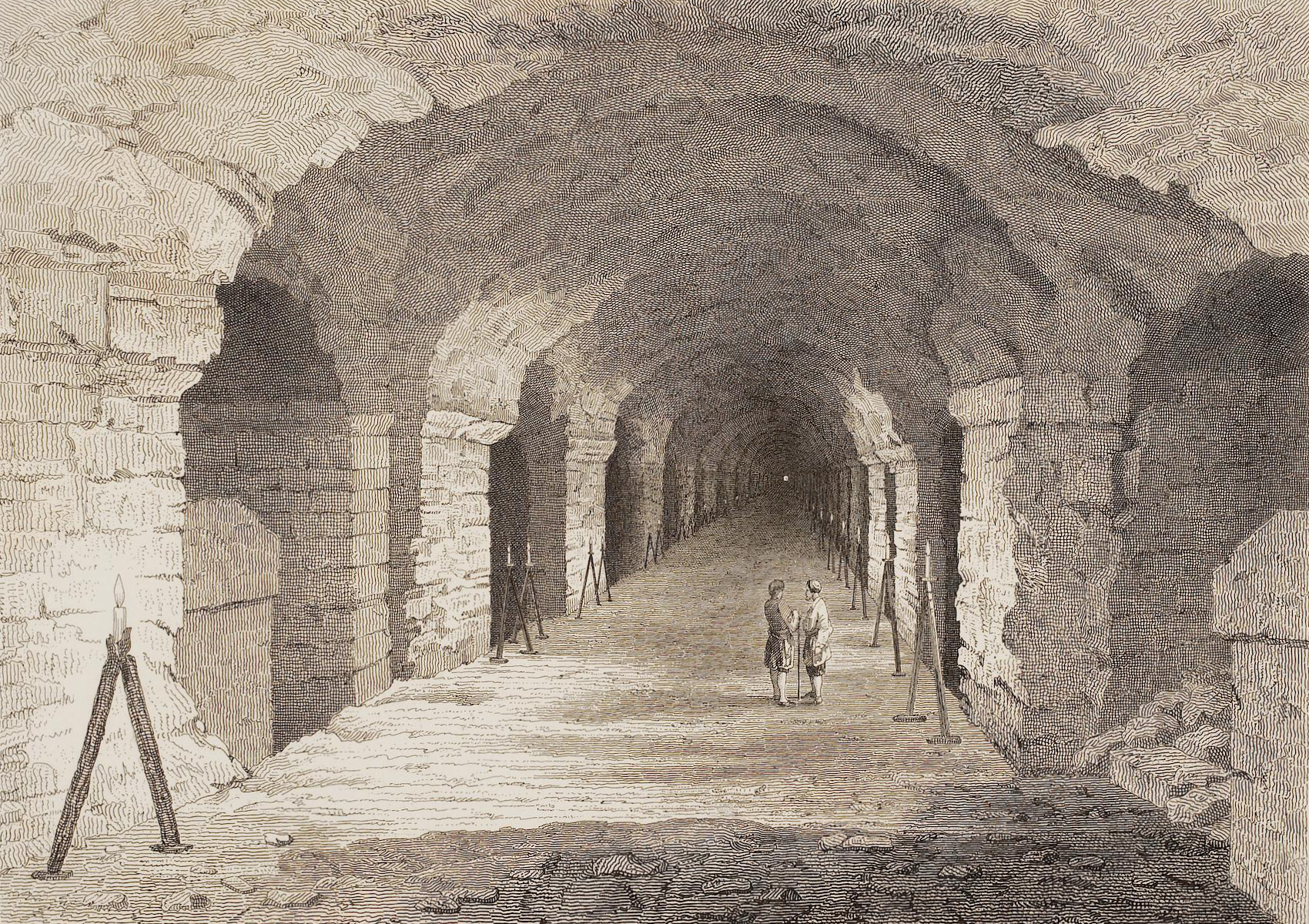
What do you put in a box that weighs seventy tons, carved from a single block of granite-hard stone, polished inside to a glassy finish, and then lowered into a pit below the floor of a tunnel barely wide enough to fit it?
The official answer at the Serapeum of Saqqara is a dead bull. Egyptologists identify the underground galleries as the burial place of the Apis bulls, sacred animals of the god Ptah at Memphis, used from the New Kingdom down to the Ptolemies. In Echoes of History I call that explanation frustrating and wrong. The great boxes were empty, too big for any bull, and in my view were made by a far older people using sacred science, to store something valuable that never arrived. “We cannot do it today, and no technology can do it.”
In this article
- What is the Serapeum of Saqqara?
- What Egyptologists say the boxes were for
- Why I reject the bull tomb explanation
- The engineering problem
- The mainstream answer to the engineering
- The Book and the Egyptologist in the Great Gallery
What is the Serapeum of Saqqara?
The Serapeum is a network of rock-cut tunnels and vaults under the desert at Saqqara, near ancient Memphis. The French Egyptologist Auguste Mariette found it in 1850, following a line of half-buried sphinxes, and spent the next years clearing it.
It has two main parts. The Lesser Vaults, or Small Gallery, hold burials from the New Kingdom; Egyptologists link their start to Khaemwaset, a son of Ramses II and a high priest of Ptah. The Greater Vaults, or Great Gallery, stretch for more than 300 metres. Along them sit 24 huge boxes in side chambers, each cut from one piece of stone. The book gives their weight as up to 70 tons, with lids of about 30 tons.
The name comes from Serapis, a god promoted under the Ptolemies who combined Osiris with the Apis bull.
What Egyptologists say the boxes were for
The mainstream account ties the Serapeum firmly to the Apis cult. A living Apis bull was chosen by its markings, kept and honoured at Memphis, and when it died it was mummified and buried with ceremony. Egypt’s Ministry of Tourism and Antiquities describes the galleries as holding those burials from the reign of Amenhotep III to the Ptolemaic period.

Egyptologists date the Great Gallery to the Late Period, beginning with Psamtik I in the Twenty-sixth Dynasty. Some boxes bear inscriptions; one carries the name of the pharaoh Amasis, and others are dated to the Persian period. Mariette also recovered a large number of stelae left by visitors and priests, many now in the Louvre, recording Apis burials across centuries.
As for the empty boxes, the standard explanation is robbery. Tombs across Egypt were stripped in antiquity, and the bulls’ gilded trappings would have been worth taking.
Why I reject the bull tomb explanation
I’ll admit I repeat myself on this in the book, because it frustrates me. The literature presents this structure “solely as a burial site for bulls,” as if the Egyptians built the impossible to serve a superstition.
Here are my reasons:
- The boxes are too big. An illustration by Ahmad Ali’s team compares a mummified bull with a Serapeum box: the box holds about four times the bull’s volume.
- Nothing was inside. When Mariette entered the Great Gallery, the boxes were open with their lids pushed slightly aside, and empty, except one that was tightly sealed. He could not move its lid and used explosives. It was empty too.
- The inscriptions are inferior. The few hieroglyphs on some boxes are rough compared with the perfect workmanship of the boxes. They were added much later, with weaker tools and less skill, so they cannot date the boxes.
- The bull cult came later. Apis appears in the Palermo Stone and the Pyramid Texts, but as a sacred bull, a symbol of strength. He was not treated as a god until much later, and the Serapeum was built long before the elaborate bull worship began.
- The small gallery tells a different story. There Mariette did find human and bull mummies, wooden coffins and plenty of inscriptions, including the gold-masked burial with the name of Khaemwaset, son of Ramses II. That gallery is simple, easy to read and was never robbed. So why would thieves have cleaned out the large one, and how, when the boxes can’t be opened in such tight spaces even with modern machines?
The engineering problem
Look at how the boxes were placed and the job gets harder at every step.

The entrance is about 3 metres wide, so a box cannot be pushed in on its side. The tunnels are narrow and badly ventilated; sending hundreds of men in to drag a 70-ton block would be impossible, and so would lighting the work with fire. The vaulted ceilings were cut into limestone in darkness. Each pit sits against a wall, and the boxes were set about 1.2 metres below the tunnel floor after a sharp turn from the path into a narrow slot.
The inside of each box is cut with more precision than the outside. “The precision on the inside must be a functional precision,” I write, and it was certainly not for a mummy’s comfort. Some boxes were polished to a glass-like surface, others left rough, and one was abandoned in the passageway, which suggests the builders stopped in haste. That box is still there, I note, because modern archaeologists can’t move it either.
As I put it: “It’s almost as if they plan an impossible mission from the start, and then make it harder and harder with each step.” My conclusion is the one in the book: “The only explanation for the phenomena is MAGIC, or sacred science or divine knowledge.” I think the boxes were made to store very valuable items, and that something stopped the builders before they could fill them. Maybe the Flood.
The mainstream answer to the engineering
Egyptologists don’t think the boxes were easy. They think the methods are known in outline. Egyptian masons shaped granite by pounding it with dolerite balls and cutting it with copper saws fed with quartz sand as an abrasive; the unfinished obelisk at Aswan still shows the pounding marks. For moving colossal weights, the tomb of Djehutihotep at Deir el-Bersha shows a statue on a sledge with a man pouring water in front of it, and a 2014 University of Amsterdam study found that wetting sand to the right degree roughly halves the force needed to pull a sledge. Inside the Serapeum, Egyptologists suggest the boxes were moved on rollers and sand, then lowered by removing sand from beneath them.
The Book and the Egyptologist in the Great Gallery
The Book: Start with the size. Why make a box four times larger than the animal?

The Egyptologist: Egyptian sacred burials were never sized for efficiency. The bull would be mummified, wrapped, placed in a wooden coffin with goods. The stone box honours it, and a bigger box is a bigger honour.
The Book: Then where are the bulls? You found them in the small gallery. In the great one you found empty boxes.
The Egyptologist: We have the stelae and dated inscriptions on the boxes themselves. One names Amasis. That puts the gallery in the Late Period, whatever was taken from it.
The Book: A name scratched on a box tells me who wrote on it. Look at those hieroglyphs beside the finish of the stone. A different hand, with different tools.
The Egyptologist: That’s an impression, not a measurement. Inscriptions were often cut by different workers from those who dressed the stone. It happens all over Egypt.
The Book: Then explain the theft. The small gallery is full of gold, untouched. The great gallery’s boxes are all opened, in slots too tight for any lever. And one Mariette found sealed, and it was empty anyway.
The Egyptologist: Robbers had centuries and knew where the valuables were. Lids can be wedged and pried a few centimetres at a time; you don’t need to lift them off. As for the sealed one, an empty sealed box is odd, I grant you. It may never have been used.
The Book: That’s my point. Never used. Unfinished, abandoned in haste, one box left in the corridor. Something stopped them.
The Egyptologist: Or the cult simply had more boxes than bulls by the time it ended under the Ptolemies.
The Book: You still haven’t told me how they turned a 70-ton box off a 3-metre corridor into a narrow pit and dropped it 1.2 metres, in the dark.
The Egyptologist: Sand and patience, we think. I’ll be honest that no one has reconstructed every step.
The Book: Then we agree on more than you’d like. Neither of us can show how it was done. I’m the only one saying so out loud.
FAQ
What is the Serapeum of Saqqara?
It is an underground complex of tunnels and vaults at Saqqara, near Memphis, discovered by Auguste Mariette in 1850. Its Great Gallery runs more than 300 metres and holds 24 massive stone boxes. Egyptologists identify it as the burial place of the sacred Apis bulls.
How heavy are the Serapeum boxes?
Echoes of History gives weights of up to 70 tons for a box, each cut from a single block, with lids of around 30 tons. They sit in pits about 1.2 metres below the tunnel floor. The book describes them as cut from extremely hard stone; Egyptologists identify most as granite. Some have interiors polished to a glassy finish.
Were bulls found in the Serapeum?
Bull remains and burials were found in the Lesser Vaults, including the burial bearing the name of Khaemwaset, son of Ramses II. Mariette found the great boxes of the Great Gallery open and empty, including one sealed box he opened with explosives. Egyptologists blame ancient robbery; the book rejects that explanation.
What does Echoes of History say the Serapeum was for?
The book argues the boxes were made by an advanced ancient people using sacred science to store very valuable items. The builders appear to have been interrupted before finishing, perhaps by the Great Flood. Later Egyptians used the site and added inferior inscriptions, which the book says cannot date the boxes.
Sources
- Egyptian Ministry of Tourism and Antiquities, “Serapeum,” egymonuments.gov.eg
- Auguste Mariette, Le Sérapéum de Memphis
- Geraldine Pinch, Egyptian Myth: A Very Short Introduction (Oxford University Press, 2004)
- A. Fall et al., “Sliding friction on wet and dry sand,” Physical Review Letters 112 (2014)
Keep Reading
- The Osireion at Abydos: Egypt’s Most Mysterious Temple
- Were the Pyramids Tombs? The Purpose of the Great Pyramid
- Harut and Marut: The Two Angels of Babylon and the Origin of Magic
- Ancient Egyptian Religion: Gods, Afterlife and a Hidden Unity
Echoes of History puts the Serapeum alongside the pyramids and the Osireion as evidence of a civilization older than the dynasties. Read the chapter and judge whether the bull explanation still holds.
Go deeper: explore our full guide in this topic hub, read a free sample, or get the complete argument in Echoes of History.