Quick answer
The Pyramid Texts are the oldest substantial body of Egyptian religious writing: spells carved inside late Old Kingdom pyramids, first in the pyramid of Unas around 2350 BCE. They protect the dead king and describe his rebirth, his union with Osiris and his ascent to the sun god and the stars. They are not found in Khufu’s Great Pyramid.
How to read this page
- Established: observed, measured, excavated or written in a source from the time. The only things we present as fact.
- Mainstream theory: what most specialists currently conclude. Reported accurately, not endorsed.
- Alternative or debated theory: proposals outside or at the edge of mainstream scholarship, or still disputed. Reported so you can see the debate.
- The book’s view: the argument of Echoes of History, always labelled as the author’s own.
Religious formulae inscribed in royal pyramids
The Pyramid Texts are a collection of religious formulae inscribed in the inner chambers of late Old Kingdom pyramids.1 Their earliest surviving example is in the pyramid of Unas, and the corpus continued in pyramids of later kings and some queens.1 They are not inscriptions inside Khufu’s Great Pyramid.
That simple clarification prevents a major confusion. The age of the Great Pyramid, the first surviving Pyramid Texts and the possible earlier history of individual formulae are three different subjects.
Echoes of History explores sacred wisdom through monuments and religious texts. The Pyramid Texts offer a valuable bridge between those interests because they show an Egyptian royal funerary setting accompanied by actual religious language, not merely meanings inferred from architecture.
For a broader overview of this subject, see our main page on the Pyramid Texts.
A corpus, not one book written at one moment
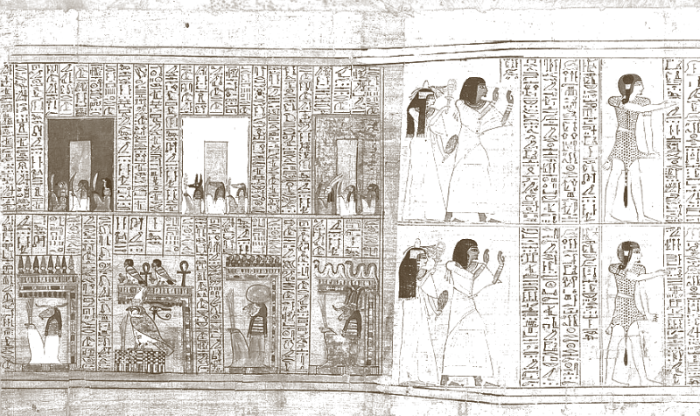
UCL describes the Pyramid Texts as a corpus of formulae, rather than a single continuous composition.1 Different settings preserve different selections, and some material continued to be used in later periods.1 The modern name identifies a group of sources; it should not be mistaken for an ancient book title describing one author’s finished work.
This matters for readers searching for “the meaning” of the texts. There may be recurring concerns, but individual passages need their own context. A general explanation should not make every formula say exactly the same thing.
A careful translation also distinguishes preserved wording from editorial reconstruction. Ancient texts can be damaged, difficult or variable. A readable modern sentence may depend on scholarly decisions that become important when a larger argument rests on one word.

Why the inscriptions belong to ritual
UCL identifies the material as formulae used in religious and funerary contexts, some of which continued in later ritual settings.1 The texts are therefore not merely decorations on chamber walls. Their wording belongs to practices concerned with the royal dead and the divine world.
This connection changes how they should be read. A ritual formula is not necessarily a modern historical description or a scientific proposition. Its function can include addressing, identifying, protecting or transforming its subject within a religious framework.
The distinction does not make the language unreal or unimportant. It means its purpose should guide interpretation. We should ask what a formula was intended to do in its setting before asking whether it can be converted into an external factual claim.

What they show about burial and religion
The placement of these religious formulae within royal pyramids provides direct evidence that such monuments were settings for funerary religious thought.1 This supports the broader interpretation of pyramids as parts of royal funerary complexes.2 Burial and sacred meaning were not competing explanations.
The texts also show why a pyramid cannot be fully understood through geometric measurements alone. Architecture was part of an institution involving religious language and continuing concern for the royal dead.1,3 A theory of function must account for that wider setting.
However, the presence of texts in later pyramids does not establish that every earlier pyramid contained precisely the same beliefs in the same form. Chronology remains part of the interpretation.
Did the texts preserve older traditions?
Individual formulae may have histories earlier than their surviving inscription, but establishing the age of that history requires argument. UCL’s secure starting point for surviving examples is Unas.1 The difference between preservation and origin should remain explicit.
This is especially relevant to Echoes of History’s interest in inherited sacred knowledge. A tradition can be older than its earliest surviving copy. Yet the possibility of age does not justify assigning any desired prehistoric date.
The same problem appears across ancient literature. We may distinguish oral or ritual antecedents, a composition’s development and a surviving witness. Conflating them can make a continuity argument appear much stronger than the evidence actually allows.
How later use changes the picture
UCL notes that formulae from the corpus appear in burial chambers of officials and on coffins in later periods, and that some continued into the New Kingdom and Late Period.1 Religious language could therefore persist while its recipients and settings changed.
That is a genuine example of continuity, but not necessarily unchanged meaning. A formula used in one royal setting may be adapted within another social or ritual context. Continuity can involve selection, reinterpretation and expansion.
This offers a more historically grounded model of sacred memory than the assumption that a complete original doctrine was preserved word for word. Traditions survive through use, and use can transform them.
Do the texts prove Egyptian monotheism?
Egyptian religious traditions preserved several creator accounts and multiple divine figures.4 The existence of profound religious language in the Pyramid Texts does not, by itself, prove an exclusive one-God doctrine across Egyptian history. A specific claim requires specific passages and interpretation.
Echoes of History proposes an underlying Creator behind the diversity of ancient divine names. The texts can be considered within that proposal, but the hypothesis should not be represented as an uncontested conclusion of Egyptology.
The responsible question is more precise: how does a particular formula relate creator language, royal identity and other gods? That allows the source to complicate the book’s interpretation rather than simply serve as decoration for it.


What about hidden scientific knowledge?
Sacred language can be sophisticated without encoding a modern scientific theory. A comparison involving stars, ascent, light or transformation needs to distinguish religious symbolism from technical explanation. Similar vocabulary does not automatically carry identical concepts.
To claim a scientific prediction, one would need a clear reading that specifies a result beyond broad metaphor and does not depend entirely on knowledge discovered later. The source must do more than accommodate a modern interpretation after the fact.
The book’s idea of sacred wisdom can be stated without reducing wisdom to modern physics. It can involve questions of existence, purpose and divine order. Those are substantial subjects even where no predictive scientific claim is established.
How should a reader begin?
Start with a translated edition that explains the organization and context of the material. James P. Allen’s The Ancient Egyptian Pyramid Texts provides a dedicated translated resource rather than only a selection of striking lines.5 Read the introductions and notes alongside the formulas.
Then compare a passage with its setting. Which pyramid preserves it? Who is addressed? What kind of ritual action or identification is involved? What other divine names appear? Those questions are more useful than searching only for an isolated sentence that resembles later scripture.
Finally, keep interpretation labeled. A source can be compared with the book’s idea of sacred memory without being claimed as direct proof of it.
Why this is a valuable question for Echoes of History
The Pyramid Texts bring the inquiry closer to ancient voices. Monumental architecture can suggest religious purpose, but an inscribed formula provides a different kind of evidence.1 It helps readers see what Egyptian religious expression actually looked like within a particular historical setting.
The clear answer is that the Pyramid Texts are late Old Kingdom royal funerary religious formulae first surviving in Unas’s pyramid, with a later history of reuse.1 Their deeper significance requires close reading, not an assumption that every line reveals the same universal doctrine.
What is fact and what is theory
| Claim | Status | Basis |
|---|---|---|
| The earliest Pyramid Texts are in the pyramid of Unas | ESTABLISHED | Inscribed burial chambers at Saqqara |
| The texts are ritual formulae for the king’s afterlife | ESTABLISHED | Content and placement of the spells |
| Some spells preserve older oral traditions | MAINSTREAM THEORY | Linguistic and content analysis |
| The texts encode hidden modern science | DEBATED THEORY | No support in the texts |
| Sacred texts may carry ancient divine wisdom | THE BOOK’S VIEW | The author’s interpretation in Echoes of History |
What the book argues · the author’s view
Echoes of History explores sacred texts as possible carriers of ancient wisdom. Read that interpretation alongside the particular wording, context and chronology of the Egyptian sources.

From the author of this guide
Explore this question in Echoes of History
Echoes of History reads Egypt’s sacred texts as possible carriers of ancient wisdom.
Frequently asked questions
Where are the Pyramid Texts found?
On the walls of burial chambers and corridors in Saqqara pyramids of the Fifth and Sixth Dynasties, beginning with Unas, and later in some queens’ pyramids.
Are the Pyramid Texts older than the Book of the Dead?
Yes. They developed into the Coffin Texts of the Middle Kingdom and later the Book of the Dead.
Do the Pyramid Texts contain hidden science?
No. They are ritual and religious texts concerned with the king’s afterlife, not technical manuals.
Further reading and resources
Book links in this list are affiliate links to Amazon and Bookshop.org. As an Amazon Associate, Jossef Salman earns from qualifying purchases, at no extra cost to you.
- The Ancient Egyptian Pyramid Texts — James P. Allen, trans. (2005)The most directly relevant reading for this question.Amazon · Bookshop.orgPrimary texts
- Egyptian Myth: A Very Short Introduction — Geraldine Pinch (2004)A broader introduction to the myths and divine relationships surrounding Egyptian texts.Amazon · Bookshop.orgIntroduction
- Echoes of History — Jossef Salman (2nd ed. 2026)Ancient religion, scripture and cosmology read as pointing to one Creator, with evidence and belief labelled.The author’s book
Sources
- UCL Digital Egypt for Universities, Pyramid Texts
- Metropolitan Museum of Art, Egypt in the Old Kingdom
- UCL Digital Egypt for Universities, Cult and temple ritual
- UCL Digital Egypt for Universities, Creation myths
- Society of Biblical Literature, James P. Allen, The Ancient Egyptian Pyramid Texts, second edition
