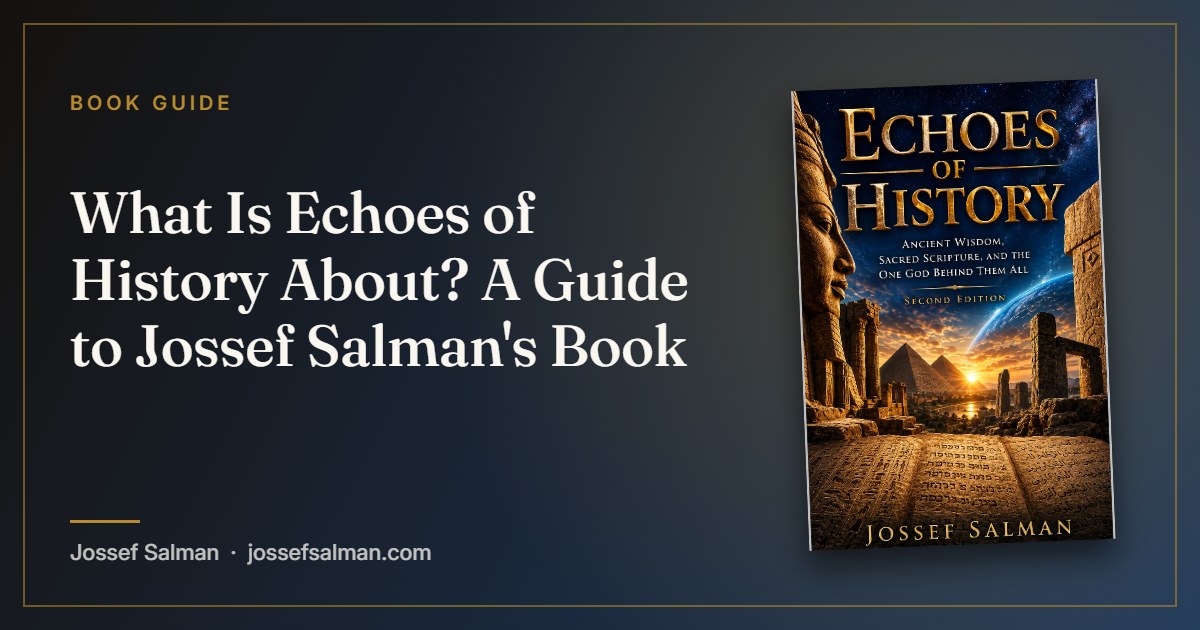
Echoes of History is a long book with a short central question: did humanity invent the idea of God, or receive it? This guide summarises what the book covers, how it argues, who it is for, and how to read it well.
Quick answer
Echoes of History: Ancient Wisdom, Sacred Scripture, and the One God Behind Them All (Second Edition, 2026) by Jossef Salman is a critical investigation into ancient civilizations, sacred texts and the possibility that humanity’s many religious traditions preserve traces of an earlier knowledge of one Creator. It travels from Göbekli Tepe and questions of creation to Mesopotamia, Egypt, Abraham, Moses, and the Torah, Gospel and Qur’an. Salman writes openly as a Muslim and presents the central idea as his argument, not a conclusion readers must accept.

| Author | Jossef Salman |
| Edition | Second Edition, 2026 (first edition 2022) |
| Length | 431 pages |
| ISBN | 9798325834240 (paperback) |
| Formats | Kindle, paperback |
| Subjects | Ancient history, archaeology, comparative religion, Egypt, Mesopotamia, scripture, science and creation, God |
The central question
The book asks whether ancient people invented gods to explain frightening natural forces, or whether belief in a Creator was inherited and later transformed into different religious systems. Salman favours the second explanation. He examines recurring ideas — creation, divine authority, sacred knowledge, kingship, and the relationship between humanity and the divine — and argues that they may be echoes of a shared origin.
It is built around three questions that open the first chapter: who is God, how is He known, and what does He ask?
What the book covers
| Part | Chapters |
|---|---|
| Beginnings | The Eternal Quest; The Veil of Perception; How Ancient Gods Came to Existence; Imagination or Knowledge |
| Creation | Creation; Creation Between Science and Scripture; Creation of Mankind; The First Man |
| Early history | Enoch and the Fallen; Noah and the Flood; Post-Flood Civilization and the Tower of Babylon; Mesopotamia |
| Patriarchs | Abraham; Joseph, Moses and the Exodus; The Pharaoh of the Exodus |
| Egypt | The History of Egypt; Dating of the Sphinx; Egypt before Dynasties; the Serapeum; the Pyramids of Giza; the Osireion |
| Religions | The Religion of Egypt; The Hebrew Religion; The Birth of Christianity; The Final Message, Islam |
| Sacred books & God | Torah, Kabbalah, Gospel, Qur’an, Emerald Tablet; What Begins Had to End; God |
The author’s approach
Salman separates evidence from interpretation on the page: he says where he is expressing belief and asks readers to question his historical claims and textual readings. The Preface identifies Göbekli Tepe as a starting point for wondering what prehistoric people valued beyond survival, while cautioning that the site does not prove a hidden advanced civilization. The second edition also withdraws more than a dozen of the first edition’s claims, with reasons.
“Faith should not need me to be afraid of evidence.”
— Jossef Salman, from the Preface
Where it follows the mainstream — and where it does not
| Topic | What the book argues |
|---|---|
| Göbekli Tepe | Accepts the dating (c. 9600–8200 BCE) and asks what the effort says about early human reaching beyond survival. |
| Origin of belief in gods | Accepts that gods took local forms, but argues the underlying idea of a higher being was received, not invented. |
| The Sphinx | Presents Robert Schoch’s weathering argument for an older core, with the counter-arguments. |
| The pyramids | Holds that the Great Pyramid is not adequately explained as a tomb, and marks his attribution to Enoch as belief. |
| The Exodus | Argues for a historical Exodus with a much earlier date (around 1807 BCE) — and says openly that this is a large claim. |
Who may enjoy it
- Readers who like big questions at the meeting point of ancient history, religion, philosophy and science.
- Readers interested in a Muslim author’s account of how Judaism, Christianity and Islam relate to older civilizations.
- People drawn to Egypt, the pyramids and the Sphinx who want the debates laid out with counter-arguments.
- Believers and seekers who want a book that does not pretend evidence and faith are the same thing.
It is less suited to readers seeking a narrowly specialist Egyptology monograph or a neutral survey textbook: its scope is broad and its conclusions are openly theological.
How to read it responsibly
Treat each section according to its evidence. Archaeological dates and inscriptions can be checked against specialist research; scriptural interpretations can be compared with translations and commentary; claims about a divine source are philosophical or theological arguments. The most productive approach is neither to accept every connection at face value nor to dismiss the book because it has a faith perspective — identify what kind of claim is being made and judge it by the right standard.
From the author of this guide
Read the opening, then decide
The Preface of Echoes of History is free to read on this site. The book is available on Amazon in Kindle and paperback.
Frequently asked questions
Is Echoes of History about ancient Egypt?
Egypt is a major subject — with chapters on its history, the Sphinx, Egypt before the dynasties, the Serapeum, the pyramids of Giza, the Osireion and Egyptian religion — but the book also covers Mesopotamia, prehistoric archaeology, human origins and Abrahamic scripture.
Is it a Muslim book?
Jossef Salman identifies himself as a Muslim and interprets the history of religion from that perspective, while reading Jewish and Christian sources as historical evidence of great value.
Does it argue that all ancient religions were originally monotheistic?
It argues that ancient traditions preserve traces of an original knowledge of one Creator. It does not claim all religions are secretly identical, and it distinguishes that thesis from scholarly consensus.
What is the book’s full title?
Echoes of History: Ancient Wisdom, Sacred Scripture, and the One God Behind Them All, Second Edition (2026), by Jossef Salman.
How long is it, and where can I buy it?
The second edition runs to 431 pages and is available on Amazon in Kindle and paperback (ISBN 9798325834240).
Is there a free sample?
Yes — the opening of the Preface is published on this site’s Read a Sample page.
Sources and further reading
