
Quick answer
The Serapeum of Saqqara was the burial place of the sacred Apis bulls, living manifestations linked with the god Ptah of Memphis. Used from Amenhotep III through the Ptolemaic period, its underground galleries hold huge granite sarcophagi. Stelae left by pilgrims and officials confirm this purpose; impressive stonework does not make it a machine.
How to read this page
- Established: observed, measured, excavated or written in a source from the time. The only things we present as fact.
- Mainstream theory: what most specialists currently conclude. Reported accurately, not endorsed.
- Alternative or debated theory: proposals outside or at the edge of mainstream scholarship, or still disputed. Reported so you can see the debate.
- The book’s view: the argument of Echoes of History, always labelled as the author’s own.
It was a burial complex for sacred Apis bulls
The Serapeum at Saqqara was used for the burial of sacred Apis bulls associated with the god Ptah and the religious center of Memphis.1 Egypt’s Ministry of Tourism and Antiquities describes its corridors as housing the mummified remains of those bulls and places the site’s use from the reign of Amenhotep III through the Ptolemaic period.1 Its enormous stone sarcophagi are part of that religious and funerary setting, not objects without an identified context.
This answer is more specific than “a mysterious underground temple.” It identifies who was buried, why those animals mattered and how the complex belonged to Egyptian religion.
Echoes of History discusses the Serapeum as an example of enigmatic ancient achievement and possible sacred wisdom. The site deserves rich exploration without obscuring its well-attested function. Engineering questions deserve attention, but they should not be used to erase the burial evidence.
For a broader overview of this subject, see our main page on the Serapeum of Saqqara.
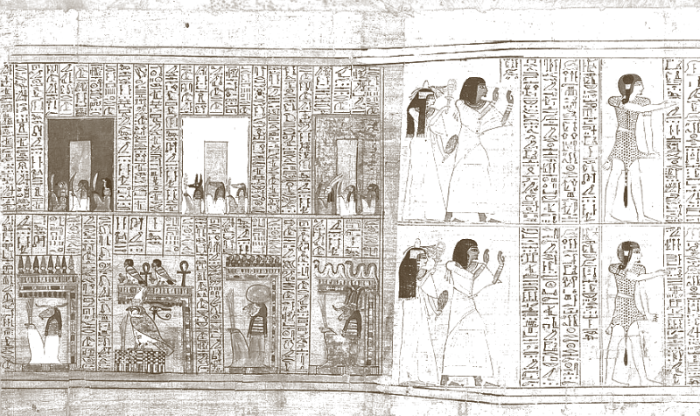
Why particular bulls were sacred
Priests selected Apis bulls according to distinctive markings and a conception of divine birth, and the chosen animals received exceptional treatment during life.1 This was not simply a mass cemetery for ordinary cattle. The ritual significance depended on the status of particular animals.
The cult’s association with Ptah places it within the religious world of Memphis.1 Egyptian religious practice could channel service through visible forms, while UCL stresses that the image or material form was not simply identical to the divine force itself.2,3 That broader distinction helps modern readers avoid reducing the cult to the sentence “Egyptians worshipped any bull.”
For Echoes of History, the interesting question is how a material creature became a focus of sacred meaning. The historical answer concerns an Egyptian cult; the book’s larger interpretation asks whether such forms preserve or transform an older divine understanding.

What happened when an Apis bull died?
The official monument account states that the bulls were mummified, placed in sarcophagi and honored through elaborate ceremonies.1 Burial was therefore the continuation of a sacred relationship, not merely disposal of an animal body.
The same account mentions inscriptions recording royal offerings and the involvement of princes and high priests associated with Ramses II.1 That evidence ties the complex to named people and institutions. It makes the purpose more secure than a theory based only on the appearance of the stone boxes.
These sources should be considered together. Architecture can indicate what a space could accommodate; inscriptions can identify participants, offerings and religious associations. When several kinds of context agree, a functional interpretation becomes stronger.

Why the stonework feels mysterious
The sarcophagi and underground setting understandably attract attention. A visitor sees a finished object rather than the entire sequence of quarrying, shaping, transport and installation. What seems incomprehensible may reflect the disappearance of intermediate evidence rather than the presence of impossible technology.
That distinction is not a complete engineering explanation. It is a rule for reasoning. Before concluding that a stone object could not have been made within its known historical setting, we should ask which measurements are reliable, what comparisons are appropriate and which steps remain genuinely unresolved.
The book’s fascination with the workmanship can therefore be retained. “How was this achieved?” is a legitimate question. “The workmanship proves an unknown civilization” is a much stronger conclusion that needs evidence of that civilization.
Do empty sarcophagi disprove the burial function?
An empty container tells us that its original contents are not currently present. It does not necessarily tell us that it was never used for burial. Disturbance, robbery, removal and incomplete preservation must be considered before interpreting absence.
The Serapeum’s burial identification rests on the wider evidence of sacred bulls, mummification, inscriptions and the complex’s historical use.1 A theory based on emptiness must account for that evidence rather than treating the missing contents as if they were the only observation.
This is a common problem in ancient-mystery writing. What is missing can be narratively powerful because almost any imagined contents fit an empty space. What is present places limits on those possibilities.

Could it have been a technical installation?
Alternative theories sometimes propose that the boxes or chambers were used for unknown scientific or energetic functions. Their appeal often comes from apparent precision and the difficulty of imagining construction. Those are reasons to investigate workmanship, not independent evidence for a machine.
A technical-function proposal needs a demonstrable mechanism and contextual traces appropriate to that mechanism. It must also explain why the site has inscriptions and religious associations supporting Apis burials.1 A convincing argument cannot simply declare those associations irrelevant.
Readers should ask what observation would distinguish the technical theory from the funerary explanation. If every feature can be reinterpreted after the fact, the theory is not being tested in a meaningful way.
How religion and skill can belong together
A funerary purpose does not make the workmanship unimportant. A society may invest exceptional effort in a sacred burial precisely because the object has religious value. The official account’s emphasis on privileged treatment, elaborate ceremonies and royal offerings explains why the cult could attract substantial resources.1
Modern assumptions about usefulness can mislead us here. A very difficult object need not be a machine to justify its production within the builders’ worldview. Sacred obligation can motivate labor that looks disproportionate when judged only by present-day practical standards.
Echoes of History asks whether ancient technical achievement and sacred ideas belong to a deeper wisdom tradition. The Serapeum offers a setting for that question, but its engineering accomplishment and its religious use should not be treated as mutually exclusive options.


What we know and what remains open
The purpose of the complex is strongly identified: sacred Apis bull burial within a long-lived Egyptian cult.1 The precise reconstruction of every stoneworking and installation operation is a separate question. Confidence about overall function does not imply that every practical detail is settled.
This separation is especially valuable to readers drawn to mysteries. It lets them investigate unresolved construction issues without discarding established history. A question can be open at one level and well answered at another.
The book’s central idea is clearer when presented that way. Sacred monuments may invite reflection on divine wisdom, but mystery is not itself evidence of revelation or lost technology.
A grounded conclusion
The Serapeum was used for the mummification-related burial and honoring of sacred Apis bulls associated with Ptah.1 Its inscriptions, religious setting and documented historical use provide the basis for that conclusion.1 Its stonework remains impressive without needing to be reclassified as an unidentified technical device.
Echoes of History treats such places as invitations to examine the relationship between ancient knowledge and the sacred. The invitation is strongest when the known purpose is explained first and speculation follows only with clearly stated limits.
What is fact and what is theory
| Claim | Status | Basis |
|---|---|---|
| The Serapeum held burials of sacred Apis bulls | ESTABLISHED | Inscriptions, stelae and burial remains |
| Used from Amenhotep III to the Ptolemaic period | ESTABLISHED | Egypt’s Ministry of Tourism and Antiquities |
| Sarcophagi were moved and placed with Egyptian methods | MAINSTREAM THEORY | Engineering and archaeological study |
| The Serapeum was a lost technical installation | DEBATED THEORY | No supporting evidence |
| Such places invite reflection on ancient sacred knowledge | THE BOOK’S VIEW | The author’s interpretation in Echoes of History |
What the book argues · the author’s view
Echoes of History explores why monuments such as the Serapeum continue to provoke questions about sacred knowledge. Read its interpretation with the archaeological function and the remaining engineering questions kept distinct.

From the author of this guide
Explore this question in Echoes of History
Echoes of History visits the Serapeum as part of its search for ancient sacred knowledge.
Frequently asked questions
Who discovered the Serapeum?
French archaeologist Auguste Mariette uncovered it in 1850–51, finding the galleries and many inscribed stelae.
Why are the Serapeum sarcophagi empty?
Most were robbed in antiquity. Empty boxes do not cancel the burial function shown by inscriptions and earlier Apis burials.
What was an Apis bull?
A specially marked bull kept at Memphis and worshipped as a living manifestation connected with Ptah; on death it was mummified and buried.
Further reading and resources
Book links in this list are affiliate links to Amazon and Bookshop.org. As an Amazon Associate, Jossef Salman earns from qualifying purchases, at no extra cost to you.
- Egyptian Myth: A Very Short Introduction — Geraldine Pinch (2004)Useful for the religious ideas surrounding Egyptian divine forms.Amazon · Bookshop.orgIntroduction
- Abydos: Egypt’s First Pharaohs and the Cult of Osiris — David O’Connor (2009)A comparative study of another major sacred landscape; not a dedicated Serapeum excavation report.AmazonArchaeology
- Echoes of History — Jossef Salman (2nd ed. 2026)Ancient religion, scripture and cosmology read as pointing to one Creator, with evidence and belief labelled.The author’s book
Sources
