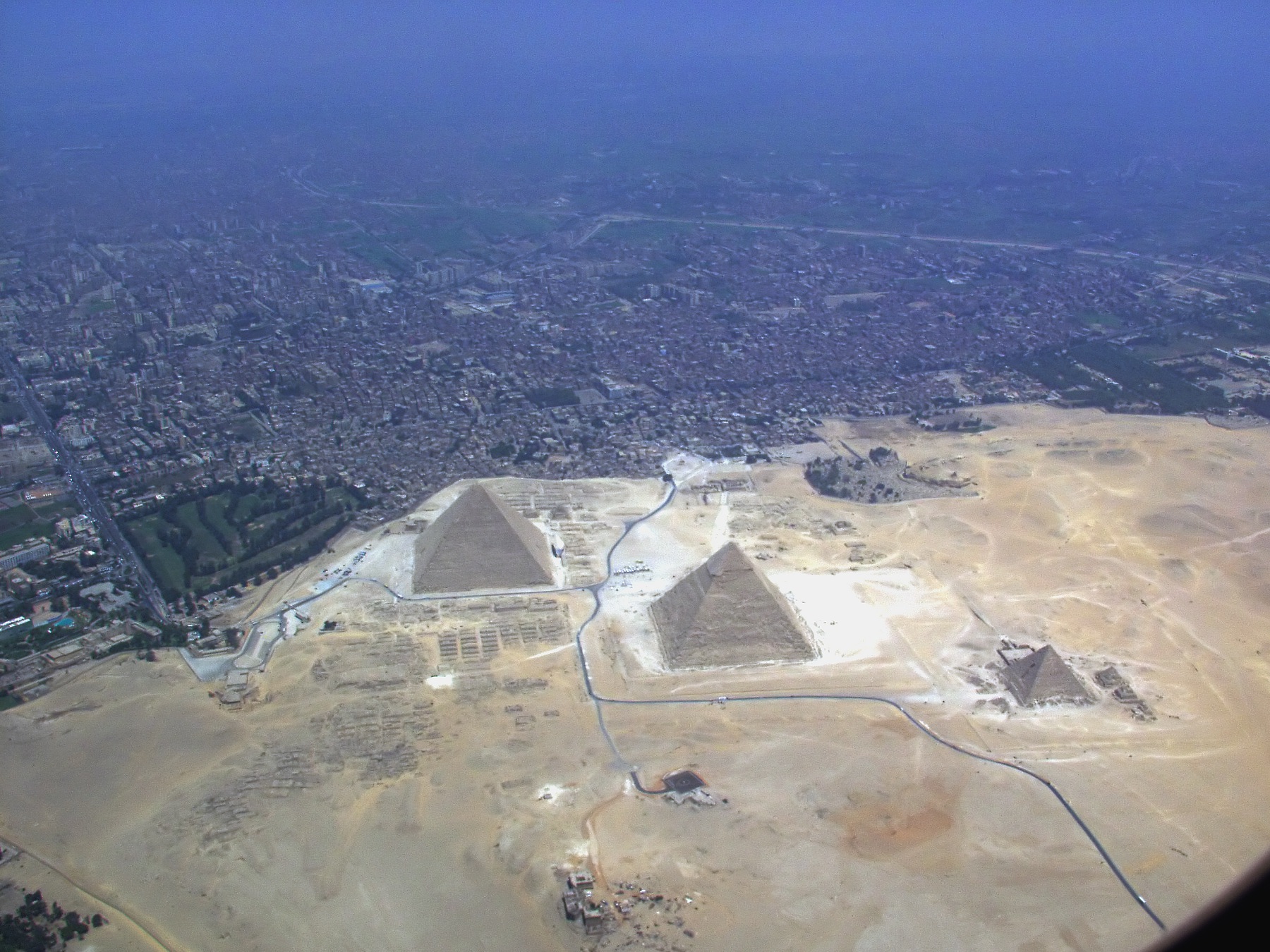
A weak king did not build the most sophisticated monument on earth in twenty years. That is my position in Echoes of History, and it is the reason this post exists. Ask who built the pyramids and you will get a confident answer from almost every textbook: three kings of Egypt’s Fourth Dynasty, Khufu, Khafre and Menkaure, around 2560 to 2500 BC, using a large and well-fed workforce.
Here is the direct answer, from both sides. Mainstream Egyptology says Egyptians of the Old Kingdom built the pyramids of Giza as royal tombs, and that the Great Pyramid belongs to Khufu (the Greeks called him Cheops). My book says the three pyramids were built long before the dynasties, by a pre-Flood civilization, and that the Islamic historians were right to credit the prophet Enoch, known to Muslims as Idris and to the Egyptians as Thoth. The rest of this post sets out why each side believes what it believes.
In this article
- Who built the pyramids, according to Egyptologists?
- Why I doubt that Khufu built the Great Pyramid
- Enoch, Sabeh and builders before the Flood
- What the three pyramids say in numbers
- Lost technology, ancient aliens, or sacred science?
- The Book and the Egyptologist at Giza
Who built the pyramids, according to Egyptologists?
The standard account is not a guess, and it is fair to lay out what it rests on.

First, there are the workers. Since the 1990s, Mark Lehner and Zahi Hawass have excavated a settlement south of the Giza plateau, sometimes called the Lost City of the Pyramid Builders (Heit el-Ghurab), with bakeries, storage and housing. Nearby is a cemetery of workers and overseers, buried in modest tombs within sight of the monuments.
Second, there are written records. In 2013 Pierre Tallet’s team found papyri at Wadi al-Jarf on the Red Sea coast. One of them, the journal of an official named Merer, logs his crew shipping limestone from the Tura quarries to Giza late in Khufu’s reign. Third, there are crew marks painted inside the stress-relieving chambers above the King’s Chamber, first entered by Howard Vyse in 1837, which include work-gang names built around Khufu’s name.
Herodotus, writing around 450 BC, adds what a priest told him: Cheops built it, over twenty years.
Why I doubt that Khufu built the Great Pyramid
I accept that Khufu existed and that he had something to do with Giza. What I do not accept is that he designed and raised the Great Pyramid.

Start with Herodotus. He is the source of the Khufu attribution, yet he also placed Cheops, Chephren and Mykerinos hundreds of years after Ramses III. Egyptologists reject that part of his story and keep the part that suits them. I think we should question both.
Then look at Khufu himself. Hatshepsut and Ramses II filled Egypt with temples and statues carrying their names. Khufu, credited with the greatest building ever made, left almost nothing. The only secure statue of him is a tiny ivory figurine found at Abydos. As I put it in the book, “It’s perplexing why a ruler responsible for such a monumental achievement wouldn’t leave behind more evidence of his greatness.”
The Westcar Papyrus adds a clue. It shows Khufu fascinated with the secret chambers of Thoth. My reading is that Khufu did not build the pyramid but sought its secrets. Perhaps he found something inside and then restored the damage he caused. That would explain why Cairo University students who carbon dated organic material between the outer casing stones got a date in his time. It proves work in his reign on parts of the exterior, nothing more.
Finally, the numbers. Moving Abu Simbel, starting in 1963, took 22 countries five years to relocate about 2,200 blocks, with modern machines and stones already carved. Egyptologists ask us to believe the Egyptians designed, quarried, moved, lifted and placed some 5 million blocks in 20 years with basic tools. That is 2,200 times the blocks in four times the time. (Most Egyptologists estimate closer to 2.3 million blocks for the Great Pyramid alone; I give the book’s figure as I wrote it, and the gap is still enormous.)
Enoch, Sabeh and builders before the Flood
If not Khufu, then who built the pyramids? The answer I give is not new. Muslim historians proposed it a thousand years ago.

Ibn Arabi identified the first Hermes with the prophet Idris, Enoch, and wrote that he lived in Egypt and built the pyramid to keep his secret books safe for the generations after the Flood. Al-Maqrizi preserved Coptic and Arab traditions of pre-Flood Egypt. The Egyptian historian Hassan Ibn Zulaq, who died in 997 AD, wrote that anyone who saw the two great pyramids would think “neither men nor jinn capable of building such a structure, and only the Creator of the heavens and the earth can handle them.”
In Echoes of History I place Enoch around 11,000 BC. Knowing the Flood was coming, he built the three pyramids of Giza to survive it and to preserve the knowledge he would leave behind. His son Sabeh completed the work and carved the Sphinx with his father’s face. Later, much weaker dynasties inherited monuments they did not understand and attached their names to them.
The method, in my view, was sacred science: divine knowledge given to humans, which let the ancients work with the laws of nature rather than against them. Schwaller de Lubicz and John Anthony West later took up this idea, but it did not begin with them.
What the three pyramids say in numbers
The builders left their signature in the plan of the plateau. I connect the three pyramids to the sequence 3, 6, 9, which Nikola Tesla is often quoted as calling the key to the universe.

“The smallest pyramid symbolizes the beginning, space, and creation, while the second pyramid symbolizes time, being the sixth in line,” I write. The Great Pyramid is the nine, the number of completion, standing for wisdom, the human spirit and the cosmos. Everything about the three, from shape to ratios, rests on these numbers. A king building his own tomb has no reason to encode a cosmology across three monuments.
Lost technology, ancient aliens, or sacred science?
People who reject the Khufu story often jump to aliens. I don’t. Zecharia Sitchin and Erich von Däniken picture humans as primitives engineered as slaves. If space travellers taught us, where is the metallurgy and machinery they would have handed over? Every species that lived on earth left traces. Aliens left none.
Lost machine technology has the same problem. If the ancients ran an energy plant at Giza, where are the tools, cables and signs of consumption? None have been found. Sacred science explains what those theories cannot: great works done with knowledge rather than brute force or hardware.
The Book and the Egyptologist at Giza
The Book: Let’s start with the obvious. Regular people with copper chisels and ropes did not build the Great Pyramid in twenty years.

The Egyptologist: They didn’t use only chisels and ropes. They had sledges, ramps, levers, a national labour system and a grain economy to feed it. We have their bakeries. We have Merer’s logbook recording stone deliveries to Khufu’s pyramid.
The Book: A logbook of limestone shipments proves someone was moving casing stone. It fits restoration as well as construction.
The Egyptologist: It fits construction better. Merer’s crew was working at the very end of Khufu’s reign, when the casing would be going on. And the gang names in the relieving chambers, places nobody was meant to see, are built on Khufu’s name.
The Book: Then explain why Khufu is so invisible. One ivory figurine the size of a thumb, for the man who supposedly built the wonder of the world.
The Egyptologist: Survival is uneven. His mortuary temple was dismantled for stone over centuries, and Old Kingdom statuary was often reused or destroyed. Absence of statues is weak evidence against a pyramid that has his crews’ names inside it.
The Book: Herodotus is your oldest witness for Cheops, and you already admit he put Cheops after Ramses III. Why trust him on the builder and not on the date?
The Egyptologist: We don’t trust Herodotus for either. The attribution comes from Egyptian evidence: the Giza cemeteries of Khufu’s family and officials, the papyri, the quarry marks. Herodotus just happened to get the name right.
The Book: I’ll grant you the cemeteries. A king can bury his family beside a monument he inherited. Al-Maqrizi and Ibn Zulaq stood in front of these pyramids a thousand years ago and concluded no ordinary men made them.
The Egyptologist: Medieval writers were honest about their amazement. Amazement isn’t a dating method, and Enoch around 11,000 BC has no settlement, tools or pottery at Giza to go with it.
The Book: Neither does your hunter-gatherer Egypt explain a monument aligned to the cardinal points and built on ratios we still argue about. You have a workforce. I am asking where the knowledge came from.
The Egyptologist: From a long tradition we can trace: Djoser’s step pyramid, then Sneferu’s experiments at Meidum and Dahshur, then Giza. You can watch them learning.
The Book: Or watch them copying. Every pyramid after Giza is smaller and worse. That is what inheritance looks like, not progress.
FAQ
Who built the pyramids of Giza according to historians?
Mainstream Egyptologists attribute the three main pyramids to Fourth Dynasty kings Khufu, Khafre and Menkaure, around 2560 to 2500 BC. The evidence they cite includes the workers’ town and cemetery at Giza, the Wadi al-Jarf papyri recording stone deliveries in Khufu’s reign, and work-gang marks bearing Khufu’s name inside the Great Pyramid.
Did slaves build the pyramids?
Most Egyptologists now say no. The workers’ tombs at Giza and their rations suggest a paid or conscripted labour force organized by the state. Echoes of History goes further and says the Great Pyramid was not built by the Fourth Dynasty at all, so the question of their workforce is beside the point for its original construction.
Who does Echoes of History say built the pyramids?
The book argues that the prophet Enoch, also called Idris and Thoth, built the three pyramids of Giza before the Great Flood, around 11,000 BC, to preserve his knowledge for later generations. His son Sabeh finished the work and carved the Sphinx. This follows medieval Muslim historians such as Ibn Arabi.
Did aliens build the pyramids?
Neither side in this post thinks so. Egyptologists credit Egyptian workers. Echoes of History rejects the ancient alien theory too, arguing that aliens would have left technological traces and passed on tools and skills. The book credits sacred science, divine knowledge given to humans, instead.
Sources
- Mark Lehner, The Complete Pyramids (Thames & Hudson, 1997)
- Pierre Tallet and Mark Lehner, The Red Sea Scrolls (Thames & Hudson, 2021), on the Wadi al-Jarf papyri and Merer’s journal
- Ancient Egypt Research Associates (AERA), project pages on the Giza workers’ town and the Great Pyramid temple, aeraweb.org
- Herodotus, Histories, Book 2
Keep Reading
- Were the Pyramids Tombs? The Purpose of the Great Pyramid
- How Old Is the Sphinx? Water Erosion and the Dating Debate
- Who Was Enoch? Idris, Hermes and Thoth as One Man
- Was Noah’s Flood Real? The Great Flood in History and Scripture
The full argument, from Enoch’s life to the 3, 6, 9 reading of Giza, is in Echoes of History. Read it with the Egyptologist’s case in hand and decide which story makes more sense to you.
Go deeper: explore our full guide in this topic hub, read a free sample, or get the complete argument in Echoes of History.