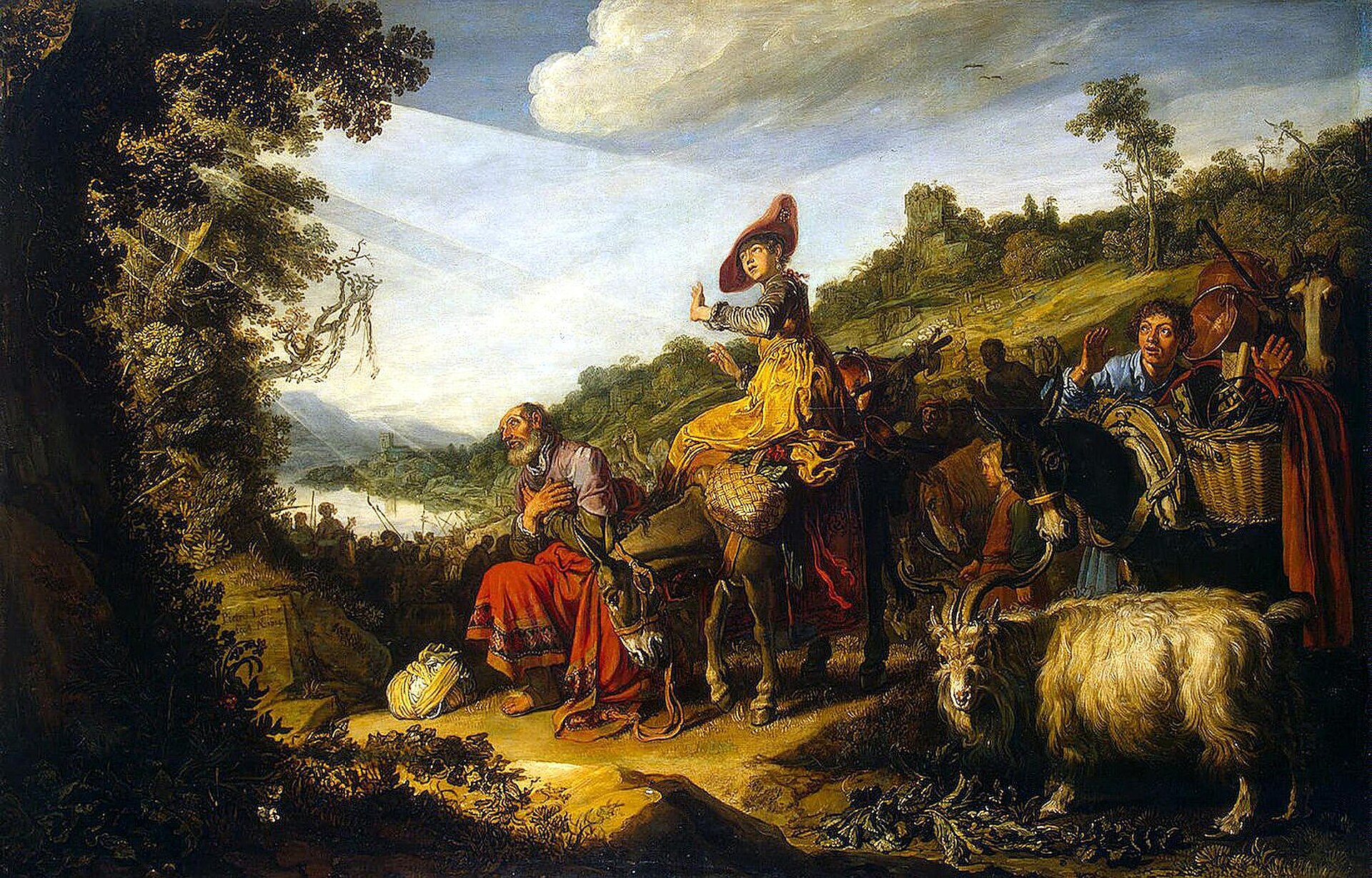
Around 2750 BC, by my reckoning, a boy was born in Ur, one of the oldest cities of Mesopotamia. His father carved statues that the people of the city worshipped as gods. The boy grew up watching the carving and came to reject it. In Echoes of History I call his birth “the first ray of hope” in a dark age after the Flood.
Who was Abraham? He is the patriarch whom Judaism, Christianity and Islam all claim as their father in faith: the man who left his homeland at God’s call, rejected idols and made a covenant with the one God. Genesis makes him the ancestor of Israel through Isaac and of other peoples through Ishmael. The Qur’an calls him Ibrahim, a hanif or upright monotheist, and has him build the Kaaba in Mecca with Ishmael. Historians cannot confirm that he lived at all, and those who think he did usually place him in the early second millennium BC. I place him much earlier, and I tell his story with details from both the Bible and the Qur’an.
In this article
- Who was Abraham in the Bible, the Qur'an and Jewish tradition?
- The life of Abraham as I tell it
- Why Abraham's date matters
- Father of three religions
- Ur, Urfa or Nowhere? The Book and the Biblical Scholar
Who was Abraham in the Bible, the Qur’an and Jewish tradition?
Genesis 11 to 25 is the main biblical source. Abram, son of Terah, sets out from “Ur of the Chaldees” with his father, his wife Sarai and his nephew Lot, stops at Haran, and then travels on to Canaan at God’s command. God renames him Abraham, “father of a multitude” (Genesis 17:5). He goes down to Egypt during a famine, fathers Ishmael with Hagar, receives three visitors who announce the birth of Isaac, pleads for Sodom, and is buried with Sarah in the cave of Machpelah at Hebron.

The Qur’an tells it differently. Abraham’s father is named Azar (6:74). The young Abraham watches a star, then the moon, then the sun, and rejects each one as it sets (6:76-79). He breaks the idols of his people except the largest, and when they throw him into a fire, God commands: “O fire, be coolness and safety upon Abraham” (21:69). With Ishmael he raises the foundations of the House in Mecca (2:127).
The fire story is not only Islamic. The Jewish midrash Genesis Rabbah (38:13) tells how Abraham smashed the idols in his father’s shop and was thrown into a furnace by Nimrod. Christians, following Paul in Romans 4, call Abraham the father of all who believe.
The life of Abraham as I tell it
In the book I follow the Islamic account where the Bible is silent, because Genesis never says why Abraham left Ur.

His father Azer was a priest who preached about the idols he carved. One festival day Abraham entered the temple and destroyed every idol except the biggest. When the people complained to their king, Nimrod, who ruled an empire stretching from Egypt to India and Turkey and is known in Arab tradition as Dahak, Abraham told them the largest idol had done it in anger. The people laughed that stone cannot act, and Abraham asked why they worshipped something so powerless. Nimrod ordered him burned alive. God made the fire cold and peaceful, and Nimrod, afraid, expelled him. That is why Abraham left Ur.
His brother Harran and Harran’s son Lot went with him. They took the old road north to Urfa (Şanlıurfa) in southern Turkey, then turned south into Syria. Harran died on the way, in a city later named Harran after him. The rest went on through Daraa in southern Syria into Jordan and crossed the Jordan River into Canaan. The Canaanites called Abraham “Abrani”, from the verb abar, to cross over. That, I argue, is the origin of the word “Hebrew”.
Abraham did not stay long in Canaan. He went down to Egypt, to Saqqara, in the reign of King Nynetjer of the Second Dynasty. His wife Sara was very beautiful and fair-skinned, and the king wanted her. When he reached out to touch her, his hand froze. He begged her to release it, tried again, froze again, and finally promised not to harm them and gave Sara an Egyptian maid, Hajar.
Back in Canaan they settled in Hebron, and Lot went to Sodom. Abraham was over a hundred, maybe 120, and had no son. At Sara’s suggestion he took Hajar as a wife, and she bore Ismael, “God heard”. When Sara grew jealous, Abraham took Hajar and the child to the Arabian desert, to the place now called Mecca. I mention a tradition that his special wisdom let him travel swiftly through space, from Hebron to Mecca in an hour, to visit them.
Two angels later came to his tent on their way to destroy Sodom and Amora, and told him he would have another son. Sarah laughed, and so the boy was called Isaac, “he laughs”. Abraham and Ismael built the House of God, the Kaaba, and began the pilgrimage that continues today. Ismael married into a Bedouin tribe and founded the first settlements of the Arabian desert. Abraham died in Hebron and was buried in a cave there beside Sarah. Isaac’s son Jacob had twelve sons, one of them Joseph.
Why Abraham’s date matters
Genesis gives only ten generations from Shem, son of Noah, to Abraham. In the Masoretic Text the numbers even let Shem outlive the generations down to Abraham’s time. I argue that this was done on purpose, to identify Shem with Melchizedek, the priest who blessed Abraham. The Greek Septuagint gives each of those generations about a hundred years more.
Neither version works for me. In Abraham’s time there were already civilizations in Babylon, Canaan and Egypt, and probably in India, Ethiopia, Turkey and the Far East as well. That means a world population of a few million, which ten generations cannot produce. My calculation puts Abraham about 5000 years after Shem and the Flood.
Father of three religions
I see Abraham as the man who restored monotheism after the Flood. His sons Ismael and Isaac carried his teaching into new nations. The word “Islam” itself goes back to Abraham, and before Muhammad there were Arabs, the Hanafiah, who kept the original religion of Abraham and Ismael. In my view the three Abrahamic faiths come from one source and are, at heart, one religion.
That is also why I object when Abraham is treated as a Jewish prophet only. He was the forefather of a large and diverse nation, of which the Jews are a small part, just as Shem’s descendants are far more than the Jewish people. Equating “anti-Semitic” with “anti-Jewish” forgets the rest of Shem’s family.
Ur, Urfa or Nowhere? The Book and the Biblical Scholar
The Biblical Scholar: Let me start with the hard part. There is no inscription, letter or object from the ancient Near East that mentions Abraham. Scholars like Thomas Thompson and John Van Seters argued in the 1970s that the patriarch stories reflect the first millennium BC, when they were written.

The Book: Writing came late to these stories, I agree. The Torah was written down long after the events. But the cities are real. Ur is real. Hebron is real. And three faiths keep the same man at their centre with the same core story.
The Biblical Scholar: The cities are real, but Genesis calls it “Ur of the Chaldees”, and the Chaldeans don’t appear in the record until the first millennium BC. Details like that suggest a later writer looking back.
The Book: That is exactly what I say about the Torah. Later hands added things. It doesn’t make Abraham invented. It makes the dates and names around him unreliable, which is why I don’t accept ten generations from Shem.
The Biblical Scholar: Your route through Urfa interests me. There’s a strong local tradition there, with the pool at Balıklıgöl tied to Abraham’s escape from the fire. And Cyrus Gordon once argued for a northern “Ur” near Haran rather than the famous Sumerian city.
The Book: I keep Abraham’s birth in Ur of Mesopotamia. From there the family took the ancient road north and settled for a time in Urfa, before turning south into Syria. Harran died on that road, and the city where he died was named after him.
The Biblical Scholar: Genesis 11:28 says Haran died in Ur, before they left, and it’s Terah who dies at Haran.
The Book: And the Bible gives no reason at all for leaving Ur. The Qur’an does: the idols, the fire, Nimrod’s fear. On the details of the family, the two accounts differ. On the cause of the journey, only one of them speaks.
The Biblical Scholar: To be fair to you, the fire story is old in Jewish tradition too. Genesis Rabbah has Abraham smashing his father’s idols and Nimrod throwing him into the furnace.
The Book: Then the story belongs to more than one tradition, even if the authors of Genesis left it out. That is how I read the scriptures in general: the core of the Bible holds truth, but the details may be inaccurate.
The Biblical Scholar: Even if we grant a historical Abraham, 2750 BC is centuries before any date biblical scholars have proposed.
The Book: Because the world he walked through was already full of cities and kingdoms. Ur, Egypt and Canaan don’t fit inside ten generations after the Flood. Move Abraham back, and the history around him starts to make sense.
FAQ
Who was Abraham in the Bible?
Abraham is the patriarch of Genesis 11 to 25, son of Terah, who left Ur for Canaan at God’s call. God made a covenant with him, and he became the father of Ishmael by Hagar and Isaac by Sarah. Judaism traces Israel through Isaac and Jacob, and Christians call him the father of all believers.
Who was Abraham in Islam?
In the Qur’an, Ibrahim is a prophet and a hanif, an upright monotheist, son of Azar. He rejects the idols of his people, survives the fire that God makes cool, and builds the Kaaba in Mecca with his son Ishmael. Muslims see Islam as the continuation of Abraham’s original religion.
Where was Abraham born?
Genesis says “Ur of the Chaldees”, usually identified with Ur in southern Iraq, excavated by Leonard Woolley. A strong tradition in Şanlıurfa in Turkey also claims his birthplace. In Echoes of History I place his birth in Mesopotamian Ur around 2750 BC and his route north through Urfa.
When did Abraham live?
No historical record dates Abraham. Scholars who accept a historical core usually suggest roughly 2000 to 1800 BC, while others see the stories as written much later. Echoes of History places his birth around 2750 BC, about 5000 years after Shem and the Flood, because ten generations cannot produce the world he lived in.
Sources
- Genesis 11:26 to 25:10; Romans 4
- Qur’an 2:127, 6:74-79, 21:51-70
- Genesis Rabbah 38:13
- Thomas L. Thompson, The Historicity of the Patriarchal Narratives (1974)
- John Van Seters, Abraham in History and Tradition (Yale University Press, 1975)
- C. Leonard Woolley, Ur of the Chaldees (1929)
Keep Reading
- Do Jews, Christians and Muslims Worship the Same God?
- Joseph in Egypt: Which Pharaoh Ruled When Joseph Arrived?
- What Was the Tower of Babel? Babylon and the Birth of Languages
- Islam and the Quran: The Final Message in the Abrahamic Story
The Abraham chapter of Echoes of History sits between the Tower of Babel and the story of Joseph, and it reads best in that order. Pick up the book if you want the whole journey from Ur to Hebron in one place.
Go deeper: explore our full guide in this topic hub, read a free sample, or get the complete argument in Echoes of History.